
oblique
Syllables: ob·lique/əˈbliːk//oʊˈbliːk/
oblique adjective: not erect or perpendicular; not parallel to, or at right angles from, the base.

Adjective
oblique (comparative obliquer, superlative obliquest)
- Not erect or perpendicular; not parallel to, or at right angles from, the base.
- Italic fonts are sometimes described as oblique in typographic terminology.
- when it has a Direction oblique to that of the former Motion, it is either added to, or subtracted from the former Motion1725, George Cheyne, Philosophical Principles of Religion, page 16
- Not straightforward; indirect; by implication; (sometimes even) obscure, ambiguous, or confusing.
- The email from HR obliquely informed her that some complaints about her had been received.
- This mode of oblique research, where a more direct one is denied, we find to be the only one in our power.1840, Thomas De Quincey, “Style. No. II”, in Blackwood's Edinburgh Magazine, page 387
- Disingenuous; underhand; morally corrupt.
- For the love we bear our friends, / Tho nere so strongly grounded, / Hath in it certain oblique ends / If to the bottome sounded1630, Michael Drayton, “The Third Nimphall”, in The Muses Elyzium
- Then would be closed the restless, oblique eye / That looks for evil, like a treacherous spy1849, William Wordsworth, “Humanity”, in The Poetical Works of William Wordsworth
- Not direct in descent; not following the line of father and son; collateral.
- His natural affection in a direct line was strong; in an oblique, but weak; for no man ever loved Children more, or a Brother less.1665, Richard Baker, “The Reign of King Henry the First”, in A Chronicle of the Kings of England, page 49
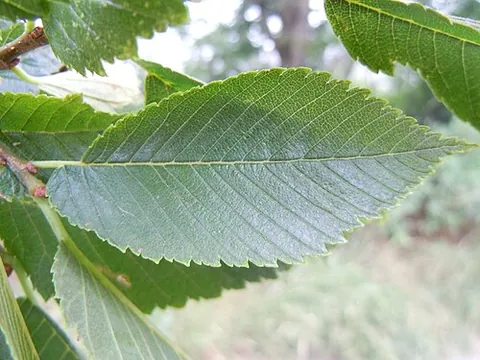
- Having the base of the blade asymmetrical, with one side lower than the other.
- Leaves long, lanceolate, tapering upward from the middle to an acute point, […] secondaries very oblique, distinct, alternate, parallel, curved in transversing the blade1892, Leo Lesquereux, The Flora of the Dakota Group, page 78
- Growing at an angle that is neither vertical nor horizontal.
- Oblique and sinker roots will normally be under a greater compression stress than lateral roots.1997, A. Stokes, D. Guitard, “Tree Root Response to Mechanical Stress”, in Arie Altman, Yoav Waisel, editors, Biology of Root Formation and Development, page 233
- Pertaining to the oblique case (non-nominative).
- Indirect; employing the actual words of the speaker but as related by a third person, having the first person in pronoun and verb converted into the third person and adverbs of present time into the past, etc.
- They found out obliquely that she had heard from HR about the comments and was taking some time to absorb the sting of an implied reprimand.
- Employing oblique motion, motion or progression in which one part (voice) stays on the same note while another ascends or descends.
- In passing from the minor third to unison, the motion ought to be oblique, but from the major third to unison the motion ought to be similar1837, Allan Cunningham, “Music”, in The Popular Encyclopedia, page 109
Noun
oblique (plural obliques)
- An oblique line.
- Synonym of slash ⟨/⟩.
- Initial inquiries among professional typists uncover names like slant, slant line, slash, and slash mark. Examination of typing instruction manuals discloses additional names such as diagonal and diagonal mark, and other sources provide the designation oblique.1965, Dmitri A. Borgmann, Language on Vacation, page 240
- Other Chaucerian manuscripts had the virgule (or virgil or oblique: /) at the middle of lines.1990, John McDermott, Punctuation for Now, page 20
- Synonyms:
- slash
- The oblique case.
- The musculus obliquus externus abdominis or also obliquus internus abdominis.
Verb
oblique (third-person singular simple present obliques, present participle obliquing, simple past and past participle obliqued)
- To deviate from a perpendicular line; to become askew.
- he sat upon the edge of his chair […] and achieved a communication with his plate by projecting his person towards it in a line which obliqued from the bottom of his spine1814, Sir Walter Scott, Waverly
- To march in a direction oblique to the line of the column or platoon; — formerly accomplished by oblique steps, now by direct steps, the men half-facing either to the right or left.
- To slant (text, etc.) at an angle.
oblique meaning in Hindi, Tamil, Marathi and Urdu
oblique in Hindi
- oblique
- बाँका bā̃kā, विकृत vikŕt
oblique in Tamil
- சரிவான, சாய்ந்த, சாய்வான, நேரல்லாத, சரிவு, சாய்வு
oblique in Marathi
- oblique, crooked
- तिरके tirke
oblique in Urdu
- آڑا, آڑی, منحرف, ترچھا, ترچھی
More languagesFewer languages
- oblique in Bengali
- তীর্যক, বাঁকা, পরোক্ষ
- oblique in Malayalam
- ചരിഞ്ഞ cariñña
- oblique in Kannada
- ಕೋಸು, ಓರೆ, ಬೂತು, ಸುತ್ತುಬಳಸಿದ
- oblique in Punjabi
- کانا kāṇā
- oblique in Gujarati
- ત્રાસું trāsũ
- oblique in Sanskrit
- जिह्म jihma
- oblique in Tagalog
- talibas
- oblique in Persian
- اریب orib
- oblique in Thai
- เฉ chěe
Examples of oblique in a sentence
- Even the most plugged-in politics enthusiasts had a hard time understanding his oblique references.
- They are crossed by oblique crowded accremental striae, producing sublenticular pitting.
- Figure 1(a) shows a novel translating follower having double oblique flat-faced configuration.
Synonyms of oblique
Forms of oblique
| Adjective | |
|---|---|
| comparative | obliquer |
| superlative | obliquest |
| Noun | |
| plural | obliques |
| Verb | |
| third-person singular present | obliques |
| present participle | obliquing |
| past participle | obliqued |
| past | obliqued |
Origin of oblique
From Middle French oblique, from Latin oblīquus (also spelled oblīcus) (“slanting, sideways, indirect, envious”).
Words formed from oblique
- deobliquing
- double-oblique
- nonoblique
- oblique angle
- oblique arch
- oblique arytenoid
- oblique ascension
- oblique bridge
- oblique case
- oblique circle
- oblique contour
- oblique cord
- oblique correction
- oblique dash
- oblique dendrite
- oblique effect
- oblique fabric
- oblique fire
- oblique flank
- oblique foliation
- oblique fracture
- oblique head
- oblique icebreaker
- oblique illumination
- oblique intent
- oblique ligament
- oblique line
- obliquely
- oblique motion
- oblique muscle
- oblique narration
- obliqueness
- oblique order
- oblique plane
- oblique projection
- oblique pyramid
- oblique reflection
- oblique rhyme
- oblique ridge
- oblique sailing
- oblique shock
- oblique spaceship
- oblique speech
- oblique sphere
- oblique stem
- oblique step
- oblique strain
- Oblique Strategies
- oblique subject
- oblique-swimming triplefin
- oblique system of coordinates
- oblique tone
- oblique type
- oblique wing
- obliquity
- single-oblique
- suboblique
- triple-oblique
- oblique stroke
- oblique mark
Phrases with oblique
- oblique cases
- oblique cords
- oblique fires
- oblique lines
- oblique marks
- oblique stems
- oblique tones
- oblique types
- oblique wings
- oblique angles
- oblique arches
- oblique dashes
36 more phrasesFewer phrases
- oblique flanks
- oblique orders
- oblique planes
- oblique rhymes
- oblique ridges
- oblique shocks
- oblique bridges
- oblique circles
- oblique fabrics
- oblique intents
- oblique motions
- oblique muscles
- oblique spheres
- oblique strains
- oblique strokes
- external oblique
- inferior oblique
- internal oblique
- oblique pyramids
- oblique subjects
- superior oblique
- oblique dendrites
- oblique fractures
- oblique ligaments
- oblique foliations
- oblique spaceships
- oblique corrections
- oblique icebreakers
- oblique projections
- oblique reflections
- oblique illuminations
- external oblique muscle
- inferior oblique muscle
- internal oblique muscle
- superior oblique muscle
- inferior oblique muscles
Words that rhyme with oblique
48 more rhymesFewer rhymes
- seek
- bespeak
- pique
- tweak
- reek
- sleek
- geek
- peek
- squeak
- week
- wreak
- boutique
- clique
- creek
- forspeak
- gleek
- unique
- bleak
- cacique
- creak
- critique
- deke
- eek
- eke
- fleak
- on fleek
- respeak
- Tajik
- teak
- technique
- tongue-in-chic
- chic
- cleek
- desqueak
- leek
- malik
- meek
- midweek
- misspeak
- physique
- pratique
- shriek
- speke
- streek
- Zeke
- -speak
- Adam's Peak
- advertique
Questions about oblique
- What does oblique mean?
- Oblique means not erect or perpendicular; not parallel to, or at right angles from, the base.
- What is oblique in Hindi?
- Oblique in Hindi is बाँका (bā̃kā), विकृत (vikŕt). See Oblique meaning in Hindi.
- What part of speech is oblique?
- Oblique can be an adjective, a noun or a verb.
- How do you pronounce oblique?
- Oblique is pronounced /əˈbliːk/ (UK).
Words near oblique in the dictionary
Source and license
Adapted from Wiktionary: oblique (page history and authors); बाँका (Hindi) (page history and authors); oblique (Tamil Wiktionary) (page history and authors); तिरके (Marathi) (page history and authors); oblique (Urdu Wiktionary) (page history and authors); oblique (Bengali Wiktionary) (page history and authors); ചരിഞ്ഞ (Malayalam) (page history and authors); oblique (Kannada Wiktionary) (page history and authors); کانا (Punjabi) (page history and authors); ત્રાસું (Gujarati) (page history and authors). Text available under the Creative Commons Attribution-ShareAlike 4.0 license. Word.ws reformatted the entry and added links. Wiktionary data of 2026-09-02.
Last updated:
Pronunciation audio from Wikimedia Commons, each file under its own free license: LL-Q1860 (eng)-Vealhurl-oblique.wav, LL-Q1860 (eng)-Knabrupt-oblique.wav.
Cite this entry: “oblique.” Word.ws, https://word.ws/oblique. Based on Wiktionary, CC BY-SA 4.0.