
ouroboros
/uːˈrɒbəˌrɒs/
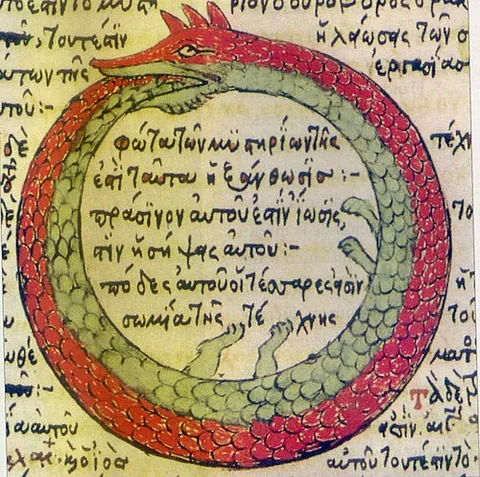
ouroboros noun: a serpent, dragon or worm that eats its own tail, a representation of the continuous cycle of life and death.

Noun
ouroboros (plural ouroboroi or ouroboroses)
- A serpent, dragon or worm that eats its own tail, a representation of the continuous cycle of life and death.
- The alchemists were fond of picturing their opus as a circulatory process, as a circular distillation or as the uroboros, the snake biting its own tail, and they made innumerable pictures of this process.1968 [1951], R. F. C. Hull, transl., Aion […] (The Collected Works of C. G. Jung), 2nd edition, volume 9.2, Princeton University Press, translation of original by C. G. Jung, →ISBN, page 264
- Khepera eating his own seed is a model of Romantic creativity, where the self is isolated and sexually dual. Khepera bent over himself is a uroboros, the serpent eating its own tail, a magic circle of regeneration and rebirth. The uroboros is the prehistoric track of natural cycle, from which...1990, Camille Paglia, Sexual Personae, Yale University Press, →ISBN, page 41
- Anything of a circular or recursive nature.
- Like an ouroboros, the story created and informed by the writer’s own experience suddenly flipped back on itself, Childress’s life now reflecting the story rather than the other way around.2019 March 6, Soraya Roberts, “Reality Bites Captured Gen X With Perfect Irony”, in The Atlantic
- The result is a statistical ouroboros: a self-reinforcing discrimination machine that amplifies social inequalities under the guise of technical neutrality.2021, Kate Crawford, chapter 4, in Atlas of AI […] , →ISBN
ouroboros meaning in Hindi, Urdu, Malayalam and Arabic
ouroboros in Hindi
- a serpent, dragon or worm that eats its own tail
- ऊरोबोरोस ūroboros
ouroboros in Urdu
- a serpent, dragon or worm that eats its own tail
- اوروبورس
ouroboros in Malayalam
- a serpent, dragon or worm that eats its own tail
- ഊറൊബോറസ് ūṟobōṟasŭ
ouroboros in Arabic
- a serpent, dragon or worm that eats its own tail
- أُورُبُورُوس ʔūrubūrūs
More languagesFewer languages
- ouroboros in Persian
- اوروبروس
Examples of ouroboros in a sentence
- One myth speaks of Ouroboros, a serpent-like creature that survived and regenerated itself by eating only its own tail.2004, Adrian Bejan et al., Porous and Complex Flow Structures in Modern Technologies, Springer Science & Business Media, →ISBN, page 121:
- First, the snake has not caught its tail—the ouroboros figure is uncompleted.2013, Jackie DiSalvo, G. A. Rosso, Christopher Z. Hobson eds., Blake, Politics, and History, Routledge, →ISBN:
Forms of ouroboros
| plural | ouroboroi |
|---|---|
| plural | ouroboroses |
| alternative form | uroboros |
Origin of ouroboros
From Ancient Greek οὐροβόρος (ourobóros, “tail-devouring”, a compound of οὐρά (ourá, “tail”) + -βόρος (-bóros, “-devouring”, which is derived from the verb βιβρώσκω (bibrṓskō, “to eat up”))).
Words formed from ouroboros
Questions about ouroboros
- What does ouroboros mean?
- Ouroboros means a serpent, dragon or worm that eats its own tail, a representation of the continuous cycle of life and death.
- What is ouroboros in Hindi?
- Ouroboros in Hindi is ऊरोबोरोस (ūroboros). See Ouroboros meaning in Hindi.
- How do you use ouroboros in a sentence?
- One myth speaks of Ouroboros, a serpent-like creature that survived and regenerated itself by eating only its own tail.
- What part of speech is ouroboros?
- Ouroboros is a noun.
- How do you pronounce ouroboros?
- Ouroboros is pronounced /uːˈrɒbəˌrɒs/.
- What is the plural of ouroboros?
- The plural of ouroboros is ouroboroi.
Words near ouroboros in the dictionary
Source and license
Adapted from Wiktionary: ouroboros (page history and authors). Text available under the Creative Commons Attribution-ShareAlike 4.0 license. Word.ws reformatted the entry and added links. Wiktionary data of 2026-09-02.
Last updated:
Pronunciation audio from Wikimedia Commons, each file under its own free license: LL-Q1860 (eng)-Vealhurl-ouroboros.wav.
Cite this entry: “ouroboros.” Word.ws, https://word.ws/ouroboros. Based on Wiktionary, CC BY-SA 4.0.