
worm
/wɜːm//wɝm/
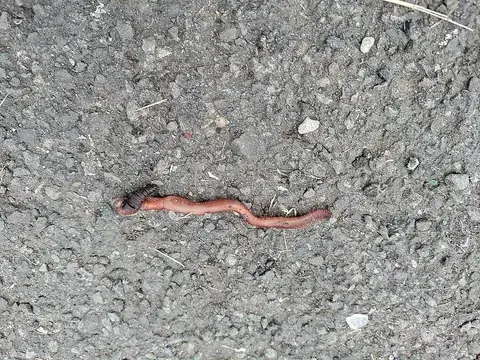
worm noun: a generally tubular invertebrate of the annelid phylum; an earthworm.

Noun (1)
worm (plural worms)
- A generally tubular invertebrate of the annelid phylum; an earthworm.
- ‘Children crawled over each other like little grey worms in the gutters,’ he said. ‘The only red things about them were their buttocks and they were raw. Their faces looked as if snails had slimed on them and their mothers were like great sick beasts whose byres had never been cleared.[…]’1963, Margery Allingham, chapter 7, in The China Governess: A Mystery, London: Chatto & Windus, →OCLC
- More loosely, any of various tubular invertebrates resembling annelids but not closely related to them, such as velvet worms, acorn worms, flatworms, or roundworms. See Appendix:English worms.
- Leaning that I might eat, I stretched and clung
Over the shapeless depth in which those corpses hung.
A woman’s shape, now lank and cold and blue,
The dwelling of the many-coloured worm,
Hung there […]1817 December, Percy Bysshe Shelley, “The Revolt of Islam. […]”, in [Mary] Shelley, editor, The Poetical Works of Percy Bysshe Shelley. […], volume I, London: Edward Moxon […], published 1839, →OCLC...
- Leaning that I might eat, I stretched and clung
- Any creeping or crawling animal, such as a snake (cf. “dragon”; blindworm, slowworm, “legless lizard”), snail, or caterpillar.
- A forlyued cok leiþ eiren in his laste elde... and ȝif any venemous worme sittiþ on broode þerevppon in þe canyculer dayes, þerof is igendrid... a cocatrice.a. 1398, John Trevisa, transl. Bartholomeus Anglicus as De Proprietatibus Rerum (MS BL Add. 27944), Vol. I, p. 628
- And when Paul had gathered a nomber of stickes, & laid them on the fyre, there came a viper out of the heat, and leapt on his hand. Now when the Barbarians sawe the worme hang on his hand, they said among them selues This man surely is a murtherer, whome, thogh he hathe escaped the sea, yet...1561, Geneva Bible, Acts 28:3-4
- A dragon, today especially Germanic dragon, more often of the serpentine or wingless type, for example sea serpent, but also any kind of dragon.
- a. 1398, John Trevisa, transl. Bartholomeus Anglicus as De Proprietatibus Rerum (MS BL Add. 27944), Vol. I, p. 628:
- In the Cross of Cong (A.D. 1123) the Celtic inter-laced patterns are found side by side with the "worm-dragon" ornament ..1922, A. Walsh, Scandinavian Relations with Ireland during the Viking Period
- Synonyms:
- wyrm
- Either a mythical "dragon" (especially wingless), a gigantic sea serpent, or a creature that resembles a Mongolian death worm.
- A contemptible or devious being.
- Don't try to run away, you little worm!
- But I am a worme, and no man; a reproach of men, and despised of the people.1611, The Holy Bible, […] (King James Version), London: […] Robert Barker, […], →OCLC, Psalms 22:6
- A self-replicating program that propagates through a network by copying itself, differing from a virus which seeks to propagate by inserting its code into other executable files.
- When Trevor opened his email, a worm spread to 100 people in his address book.
- A graphical representation of the total runs scored across a number of overs.
- Anything helical, especially the thread of a screw.
- If the Worms of the Nut or Spindle be worn, the Spindle must be examin'd by the Smith1683, Joseph Moxon, Mechanick exercises
- A spiral instrument or screw, often like a double corkscrew, used for drawing balls from firearms.
- The spiral wire of a corkscrew.
- A muscular band in the tongue of some animals, such as dogs; the lytta.
- The condensing tube of a still, often curved and wound to save space.
- A short revolving screw whose threads drive, or are driven by, a worm wheel or rack by gearing into its teeth.
- Holonyms: worm drive, worm and wheel
- An internal tormentor; something that gnaws or afflicts one’s mind with remorse.
- The worm of conscience still begnaw thy soul!c. 1593 (date written), William Shakespeare, “The Tragedy of Richard the Third: […]”, in Mr. William Shakespeares Comedies, Histories, & Tragedies […] (First Folio), London: […] Isaac Iaggard, and...
- A strip of linked tiles sharing parallel edges in a tiling.
- The lytta.
- A dance, or dance move, in which the dancer lies on the floor and undulates the body horizontally thereby moving forwards.
Verb
worm (third-person singular simple present worms, present participle worming, simple past and past participle wormed)
- To make (one's way) with a crawling motion.
- We wormed our way through the underbrush.
- I took a firm grip of Josella's hand, and we started to worm our way along as unobviously as possible.1951, John Wyndham, The Day of the Triffids, Harmondsworth: Penguin Books, published 1954, page 80
- To move with one's body dragging the ground.
- Inch by inch I wormed along the secret passageway, flat to the ground, not once raising my head, hardly daring to pull a full breath[…].1919, William Joseph Long, How animals talk: and other pleasant studies of birds and beast
- To work one's way by artful or devious means.
- When debates and fretting jealousy / Did worm and work within you more and more, / Your colour faded.[1633], George Herbert, edited by [Nicholas Ferrar], The Temple. Sacred Poems, and Private Ejaculations, Cambridge, Cambridgeshire: […] Thomas Buck and Roger Daniel; and are to be sold by Francis...
- To work (one's way or oneself) (into) gradually or slowly; to insinuate.
- He wormed his way into the organization.
- With “facts” generated by Wikipedia worming themselves into every corner of our digital lives, such as your Alexa speaker or iPhone, perhaps it’s the ubiquity of information that’s the problem – and something that should concern us all.2021 May 27, Andrew Orlowski, “You think the BBC is biased? Check out Wokepedia”, in The Telegraph
- To effect, remove, drive, draw, or the like, by slow and secret means.
- They […]find themselves wormed out of all power.1731, Jonathan Swift, The Presbyterians Plea of Merit
- To drag out of, to get information that someone is reluctant or unwilling to give (through artful or devious means or by pleading or asking repeatedly).
- They[…]wormed things out of me that I had no desire to tell.1849 May – 1850 November, Charles Dickens, chapter 17, in The Personal History of David Copperfield, London: Bradbury & Evans, […], published 1850, →OCLC
- He nodded. "Mum's the word, Mrs. Bunting! It'll all be in the last editions of the evening newspapers—it can't be kep' out. There'd be too much of a row if twas!"
"Are you going off to that public-house now?" she asked.
"I've got a awk'ard job—to try and worm something out of the barmaid."1913, Mrs. [Marie] Belloc Lowndes, chapter XXII, in The Lodger, London: Methuen, →OCLC; republished in Novels of Mystery: The Lodger; The Story of Ivy; What Really Happened, New York, N.Y.: Longmans...
- To fill in the contlines of (a rope) before parcelling and serving.
- Worm and parcel with the lay; turn and serve the other way.
- Ropes[…]are generally wormed before they are served.1841, Benjamin J. Totten, Naval Text-Book
- To deworm (an animal).
- To cut the worm, or lytta, from under the tongue of (a dog, etc.) for the purpose of checking a disposition to gnaw, and formerly supposed to guard against canine madness.
- The men[…] assisted the laird in his sporting parties, wormed his dogs, and cut the ears of his terrier puppies.1815 February 24, [Walter Scott], Guy Mannering; or, The Astrologer. […], volume (please specify |volume=I to III), Edinburgh: […] James Ballantyne and Co. for Longman, Hurst, Rees, Orme, and Brown...
- To clean by means of a worm; to draw a wad or cartridge from, as a firearm.
Noun (2) capitalized: WORM
WORM (plural WORMs)
- Initialism of write once, read many.
Proper noun capitalized: Worm
Worm (plural Worms)
- A surname.
worm meaning in Hindi, Tamil, Urdu and Bengali
worm in Hindi
- animal
- कीड़ा kīṛā, पोका pokā, किर्म kirm
worm in Tamil
- animal
- புழு puḻu
worm in Urdu
- animal
- کِیڑا kīṛā, پوکا pokā, کِرْم kirm
worm in Bengali
- animal
- কীট kiṭ
More languagesFewer languages
- worm in Telugu
- పురుగు purugu
- worm in Malayalam
- പുഴു puḻu
- worm in Kannada
- ಹುಳು huḷu
- worm in Punjabi
- ਸੁੰਡੀ suṇḍī
- worm in Odia
- କୃମି krumi
- worm in Sanskrit
- कृमि kṛmi
- worm in Sinhala
- පණු paṇu
- worm in Pashto
- چومجى čumjáy, چينجى činjáy
- worm in Arabic
- دُودَة dūda, دُود dūd, دود dūd, دودة dūda
- worm in Malay
- cacing
- worm in Indonesian
- cacing
- worm in Persian
- کِرْم kirm
- worm in Thai
- หนอน nɔ̌ɔn
- worm in Vietnamese
- giun, trùn
- worm in Myanmar
- တီကောင် tikaung, သန်ကောင် sankaung
Examples of worm in a sentence
- Indeed the allusion to the more renowned worm killed by the Wælsing is sufficient indication that the poet selected a dragon of well-founded purpose[.]1936, J. R. R. Tolkien, Beowulf: The Monsters and the Critics, Norwood, Pa.: Norwood Editions, published 1976, page 9:
- The after fifty years a foul worm, a dragon, took it upon itself to hold sway through the heavens at night.1961, Norma Lorre Goodrich, “Beowulf”, in The Medieval Myths, New York: The New American Library, page 39:
Synonyms of worm
Forms of worm
| Noun | |
|---|---|
| plural | worms |
| plural | WORMs |
| alternative form (obsolete) | worme |
| Verb | |
| third-person singular present | worms |
| present participle | worming |
| past participle | wormed |
| past | wormed |
| Proper noun | |
| plural | Worms |
Origin of worm
From Middle English werm, wirm, worm, worme, wrim, wurm, wyrm, wyrme, from Old English weorm, wurm, wyrm, from Proto-West Germanic *wurmi, from Proto-Germanic *wurmiz (“worm; snake”), from Proto-Indo-European *wr̥mis (“worm; larva”), possibly from *wer- (“to turn”). Doublet of vermin and wyrm, the latter of which is a fairly recent borrowing directly from the Old English. (computing): First computer usage by John Brunner in his 1975 book The Shockwave Rider. Cognates Germanic cognates include North Frisian wörem, wörm, Würem (“worm”), Saterland Frisian Wurm, Wúurm (“worm”), West Frisian wjirm (“worm”), Alemannic German Wüüre (“worm”), Cimbrian bórm (“worm”), burm (“snake”), Dutch worm, wurm (“worm”), German Gewürm (“vermin”), Wurm (“worm”), Low German Worm (“worm”), Luxembourgish Wuerm (“worm”), Mòcheno burm (“snake”), Vilamovian vūəm, wüm (“worm”), Yiddish וואָרעם (vorem, “worm”), Danish, Norwegian Bokmål, and Swedish orm (“worm”), Faroese and Icelandic ormur (“worm”), Norwegian Nynorsk orm (“worm”), yrme, yrmle (“female snake with offspring”), Gothic 𐍅𐌰𐌿𐍂𐌼𐍃 (waurms, “snake”), Kildin Sami уррьм (urr’m, “gadfly larva”), Skolt Sami uʹrmm (“gadfly larva”). Indo-European cognates...
Borrowed from Danish and German Worm.
Words formed from worm
- agave worm
- anchor worm
- angleworm
- antiworm
- apple worm
- army-worm
- army worm
- armyworm
- arrowworm
- arrow worm
- Asian jumping worm
- backworm
- bagworm*
- bamboo worm
- bankrupt worm
- barley worm
- basketworm
- beard worm
- beetworm
- blackworm
- bladderworm
- bladder worm
- blindworm
- blood worm*
- Bobbit worm
- bollworm*
- bone-eating snot flower worm
- book worm
- bookworm
- book-worm
- bootlace worm
- brain-worm
- brain worm
- brainworm
- bristle worm
- budworm
- buffalo worm
- burp the worm
- butt worm
- buzzworm
- cabbage worm
- caddis worm
- caddisworm
- cankerworm
- can of worms
- caseworm
- catworm
- Christmas tree worm
- clam worm
- cockworm
- coconut worm
- coco worm
- common glow-worm
- coneworm
- copperworm
- cornworm
- cotton worm
- cryptoworm
- cutworm
- deepwater big-eyed worm eel
Phrases with worm
- Y worm
- oh worm
- dew worm
- ear worm
- gun worm
- ice worm
- jaw worm
- lob worm
- maw worm
- rag worm
- red worm
- sea worm
130 more phrasesFewer phrases
- tag worm
- worm oil
- worm out
- worm red
- worm tea
- dick worm
- rope worm
- skin worm
- slow worm
- sour worm
- tree worm
- tube worm
- wolf worm
- worm ball
- worm bark
- worm cast
- worm food
- worm moon
- worm pick
- worm teas
- Yoda worm
- acorn worm
- blood worm
- gummy worm
- mango worm
- mason worm
- morio worm
- penis worm
- phlox worm
- scale worm
- spoon worm
- stoor worm
- white worm
- wooly worm
- worm balls
- worm casts
- worm drive
- worm fence
- worm fever
- worm gears
- worm month
- worm moons
- worm picks
- worm screw
- worm shell
- worm snake
- worm turns
- dragon worm
- galley worm
- goblet worm
- grugru worm
- guinea worm
- maguey worm
- medusa worm
- palmer worm
- palolo worm
- pantry worm
- peanut worm
- potato worm
- ribbon worm
- ringed worm
- spiral worm
- thorny worm
- tomato worm
- tongue worm
- velvet worm
- wiggle worm
- winter worm
- woolly worm
- worm burner
- worm castle
- worm drives
- worm fences
- worm fevers
- worm lizard
- worm months
- worm screws
- worm shells
- worm snakes
- worm wheels
- zombie worm
- fishing worm
- Gordian worm
- grindal worm
- herring worm
- jumping worm
- juniper worm
- miner's worm
- peacock worm
- Pompeii worm
- stomach worm
- worm burners
- worm castles
- worm lizards
- palisade worm
- railroad worm
- worm charming
- burps the worm
- horsehair worm
- horseshoe worm
- innkeeper worm
- measuring worm
- parchment worm
- proboscis worm
- sand tube worm
- segmented worm
- spaghetti worm
- trematode worm
- worm and wheel
- burped the worm
- giant tube worm
- sand mason worm
- worm has turned
- burping the worm
- polystyrene worm
- worm on a string
- spiny-headed worm
- worm in the apple
- indigo velvet worm
- feather duster worm
- Guinea worm disease
- Mongolian death worm
- Moser's worm problem
- thousand-legged worm
- even a worm will turn
- imported cabbage worm
- deepwater big-eyed worm eels
- the early bird gets the worm
- the early bird catches the worm
- giant thorny-headed worm of swine
Words that rhyme with worm
9 more rhymesFewer rhymes
Questions about worm
- What does worm mean?
- Worm means a generally tubular invertebrate of the annelid phylum; an earthworm.
- What is worm in Hindi?
- Worm in Hindi is कीड़ा (kīṛā), पोका (pokā), किर्म (kirm). See Worm meaning in Hindi.
- How do you use worm in a sentence?
- Indeed the allusion to the more renowned worm killed by the Wælsing is sufficient indication that the poet selected a dragon of well-founded purpose[.]
- What part of speech is worm?
- Worm can be a noun, a verb or a proper noun.
- How do you pronounce worm?
- Worm is pronounced /wɜːm/ (UK).
- What is the plural of worm?
- The plural of worm is worms.
Words near worm in the dictionary
Source and license
Adapted from Wiktionary: worm (page history and authors); WORM (page history and authors); Worm (page history and authors). Text available under the Creative Commons Attribution-ShareAlike 4.0 license. Word.ws reformatted the entry and added links. Wiktionary data of 2026-09-02.
Last updated:
Pronunciation audio from Wikimedia Commons, each file under its own free license: LL-Q1860 (eng)-Naomi Persephone Amethyst (NaomiAmethyst)-worm.wav, en-au-worm.ogg, LL-Q1860 (eng)-Back ache-worm.wav.
Cite this entry: “worm.” Word.ws, https://word.ws/worm. Based on Wiktionary, CC BY-SA 4.0.