
pelt
/pɛlt/
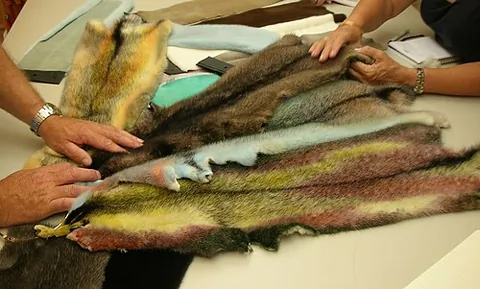
pelt noun: the skin of an animal with the hair or wool on; either a raw or undressed hide, or a skin preserved with the hair or wool on it (sometimes worn as a garment with minimal modification).

Noun (1)
pelt (plural pelts)
- The skin of an animal with the hair or wool on; either a raw or undressed hide, or a skin preserved with the hair or wool on it (sometimes worn as a garment with minimal modification).
- Perhaps the reason why he [a stuffed fox] seemed in such a ghastly rage was that he did not come by his death fairly. Otherwise his pelt would not have been so perfect. And why else was he put away up there out of sight?—and so magnificent a brush as he had too.1879, R[ichard] J[efferies], “The First Gun”, in The Amateur Poacher, London: Smith, Elder, & Co., […], →OCLC, page 1
- My people got themselves pelts and pelts—there was such a trapping as comes but few times in a life. Pelts and pelts, the silver and the grey—fine pelts.1922 July, E[velyn] Charles Vivian, “White Man’s Magic: A Story of the Canadian Mounted Police”, in The Boy’s Own Paper, volume XLV, part 9, London: “Boy’s Own Paper” Office, […], →OCLC, page 617...
- The skin of an animal (especially a goat or sheep) with the hair or wool removed, often in preparation for tanning.
- The fur or hair of a living animal.
- Near-synonym: coat
- The Cauſes and the Signs ſhall next be told, / Of ev'ry Sickneſs that infects the Fold [of sheep]. / A ſcabby Tetter on their pelts vvill ſtick, / VVhen the ravv Rain has pierc'd 'em to the quick: […]1697, Virgil, “The Third Book of the Georgics”, in John Dryden, transl., The Works of Virgil: Containing His Pastorals, Georgics, and Æneis. […], London: […] Jacob Tonson, […], →OCLC, page 116, lines...
- Synonyms:
- coat
- Human skin, especially when bare; also, a person's hair.
- Put on your dress, ye shameless witch, standin' there in your pelt I'll take a strap to, for havin' the conceit out of you, for by your idling had lost me the sup of gin to keep the breath of life in me. Cover your scut, or I'll welt the skin off it.1938, Norman Lindsay, chapter XVII, in Age of Consent, London: T[homas] Werner Laurie […], →OCLC, page 177
- A garment made from animal skins.
- The body of any quarry killed by a hawk; also, a dead bird given to a hawk for food.
- If two [hawks] are flown they are certain to fell the game at once, and the falconer is always flurried by their violent propensity to crab over the "pelt."1852, Richard F[rancis] Burton, “A Day with the Bashah”, in Falconry in the Valley of the Indus, London: John Van Voorst, […], →OCLC, page 60
Verb (1)
pelt (third-person singular simple present pelts, present participle pelting, simple past and past participle pelted)
- To remove the skin from (an animal); to skin.
- Let us take a typical case of a mink farmer here in Connecticut who is being forced to throw in the sponge this coming fall. […] He pelts from 3500 to 4000 minks a year and has a huge investment of several thousand dollars tied up in his mink business.1967, James J. Critchley, “The Plight of the U.S. Mink Farmer”, in Import Quotas Legislation: Hearings before the Committee on Finance, United States Senate, Ninetieth Congress, First Session on...
- Chiefly followed by from: to remove (the skin) from an animal.
- A gentleman (long agoe) lent him an old velvet ſaddle, […] [He] preſently untruſſeth, and pelts the out-ſide from the lining, […] with it he made him a caſe, or cover, for a dublet, which hath caſed and coverd his nakednes ever ſince: […]1596, Tho[mas] Nashe, “Dialogus”, in Haue with You to Saffron-Walden. Or, Gabriell Harveys Hunt is Up. […], London: […] John Danter, →OCLC; republished as J[ohn] P[ayne] C[ollier], editor, Have with...
- To remove feathers from (a bird).
- A Man took an Eagle, Pelted her VVings, and put her among his Hens. Somebody came and bought This Eagle, and preſently Nevv-Feather'd her.1692, Roger L’Estrange, “[The Fables of Æsop, &c.] Fab[le] CVII. An Eagle and a Man.”, in Fables, of Æsop and Other Eminent Mythologists: […], London: […] R[ichard] Sare, […], →OCLC, page 101
Verb (2)
pelt (third-person singular simple present pelts, present participle pelting, simple past and past participle pelted)
- To bombard (someone or something) with missiles.
- The children are pelting each other with snowballs.
- They pelted the attacking army with bullets.
- To force (someone or something) to move using blows or the throwing of missiles.
- […] Martin survived […] to receive absolution from the very priest, whom, precisely on that day three years, he had assisted to pelt out of the hamlet of Morgenbrodt.1816, [Walter Scott], chapter III, in The Antiquary. […], volume II, Edinburgh: […] James Ballantyne and Co. for Archibald Constable and Co.; London: Longman, Hurst, Rees, Orme, and Brown, →OCLC...
- Presently, sweetened by distance, would be heard the wild weird song of lads and lasses, driving or rather pelting, through the gloaming their sheep and goats; […]1885, Richard F[rancis] Burton, transl. and editor, “The Translator’s Foreword”, in A Plain and Literal Translation of the Arabian Nights’ Entertainments, now Entituled The Book of the Thousand...
- Of a number of small objects (such as raindrops), or the sun's rays: to beat down or fall on (someone or something) in a shower.
- The chiding billovv ſeemes to pelt the cloudes, / The vvinde ſhak'd ſurge, vvith high and monſtrous mayne, / Seemes to caſt vvater, on the burning Beare, […]c. 1603–1604 (date written), William Shakespeare, The Tragœdy of Othello, the Moore of Venice. […] (First Quarto), London: […] N[icholas] O[kes] for Thomas Walkley, […], published 1622, →OCLC, [Act...
- Ile ſtand this ſtorm of hail though the ſtones pelt me.1622 (first performance), Thomas Middleton, William Rowley, The Changeling: […], London: […] [Thomas Newcombe] for Humphrey Moseley, […], published 1653, →OCLC, Act II, signature [C4], verso
- Chiefly followed by at: to (continuously) throw (missiles) at.
- The children pelted apples at us.
- [I]n his Paroxyſms, as he vvalked the Streets, he vvould have his Pockets loaden vvith Stones, to pelt at the Signs.1704, [Jonathan Swift], “Section XI. A Tale of a Tub.”, in A Tale of a Tub. […], London: […] John Nutt, […], →OCLC, pages 203–204
- Synonyms:
- cockshy
- To repeatedly beat or hit (someone or something).
- To assail (someone) with harsh words in speech or writing; to abuse, to insult.
- I have […] had the honour to be pelted with several epistles to expostulate with me on that subject.1710 July 7 (Gregorian calendar), Isaac Bickerstaff [pseudonym; Richard Steele et al.], “Monday, June 27, 1710”, in The Tatler, number 190; republished in [Richard Steele], editor, The Tatler, […]...
- They don't knovv hovv to go about their abuſe. VVho vvill read a five ſhilling book againſt me? No, Sir, if they had vvit, they ſhould have kept pelting me vvith pamphlets.1791, James Boswell, quoting Samuel Johnson, “[1775]”, in James Boswell, editor, The Life of Samuel Johnson, LL.D. […], volume I, London: […] Henry Baldwin, for Charles Dilly, […], →OCLC, page 454
- Especially of hailstones, rain, or snow: to beat down or fall forcefully or heavily; to rain down.
- It’s pelting down out there!
- Accurſt be he that firſt inuented war, / They knew not, ah, they knew not ſimple men, / How thoſe were hit by pelting Cannon ſhot, / Stand ſtaggering like a quiuering Aſpen leafe, / Fearing the force of Boreas boiſtrous blaſts.c. 1587–1588 (date written), [Christopher Marlowe], Tamburlaine the Great. […] The First Part […], 2nd edition, part 1, London: […] [R. Robinson for] Richard Iones, […], published 1592, →OCLC...
- To move rapidly, especially in or on a conveyance.
- I pelted across to where my family was sitting.
- The bus went pelting down the hill.
- Chiefly followed by at: to bombard someone or something with missiles continuously.
- The Biſhop, and the Duke of Gloſters men, / Forbidden late to carry any VVeapon, / Haue fill'd their Pockets full of peeble ſtones; / And banding themſelues in contrary parts, / Doe pelt ſo faſt at one anothers Pate.1591 (date written), William Shakespeare, “The First Part of Henry the Sixt”, in Mr. William Shakespeares Comedies, Histories, & Tragedies […] (First Folio), London: […] Isaac Iaggard, and Ed[ward]...
- [T]heſe light armed refuters vvould have don pelting at thir three lines utterd vvith a ſage delivery of no reaſon, but an impotent and vvors then Bonner-like cenſure, […]1645 March 14 (Gregorian calendar), J[ohn] M[ilton], Colasterion: A Reply to a Nameles Answer against The Doctrine and Discipline of Divorce. […], [London?]: [s.n.], →OCLC, page 2
- To throw out harsh words; to show anger.
- [S]he [the church] holdeth the veritie of his bodie [i.e., Jesus's body in the Eucharist]: ſhe pelteth not vvith God, denying this to be his body, bicauſe ſhe is cōmaunded to do this in remembrãce of hym: but ſhe doth beſt remembre hym, vvhen ſhe hath the bodie vvhich ſuffered, before her.1564 December 1 (Gregorian calendar), Iohn Rastell [i.e., John Rastell], “[Of Corpus Christi Daye and of the Seruice of that Holye Daye]”, in A Confutation of a Sermon, Pronoũced by M. Iuell, at...
- Another ſmotherd, ſeemes to pelt and ſvveare, / And in their rage ſuch ſignes of rage they beare, […]1594, William Shakespeare, Lucrece (First Quarto), London: […] Richard Field, for Iohn Harrison, […], →OCLC, signature K2, verso
Noun (2)
pelt (plural pelts)
- A beating or falling down of hailstones, rain, or snow in a shower.
- [D]azed and blinded, she bent her head as if to let the pelt of jagged hail, the drench of dirty water, bespatter her unrebuked.1927 May, Virginia Woolf, chapter 6, in To the Lighthouse, London: Leonard and Virginia Woolf at the Hogarth Press, […], →OCLC, page 54
- Kas is awakened by the furious pelts of rain hitting the tin roof, and he rolls over, pulling his sleeping wife tightly into his arms.2013 July 15, Karen-Anne Stewart, chapter 19, in Healing Rain (The Rain Trilogy; 2), Bloomington, Ind.: AuthorHouse, →ISBN, page 134
- A blow or stroke from something thrown.
- [T]he cripple, in falling, gave him ſuch a good pelt on the head vvith his crutch, that the blood follovved.1771, [Tobias Smollett], “To Sir Watkin Phillips, Bart. of Jesus College, Oxon.”, in The Expedition of Humphry Clinker […], volume II, London: […] W. Johnston, […]; and B. Collins, […], →OCLC, page...
- A verbal insult; a jeer, a jibe, a taunt.
- A fit of anger; an outburst, a rage.
- The pope [Innocent IV] being in this pelt, Ægidus, a Spanish cardinal, thus interposed his gravity: […]1655, Thomas Fuller, “Section V. Thomæ Hanson, Amico Meo.”, in The Church-history of Britain; […], London: […] Iohn Williams […], →OCLC, (please specify |book=I to XI), subsection 29, 30 (The Pope’s...
- An act of moving quickly; a rush.
- It's a good day off us anyhow, and they're all going south-west by south full pelt as hard as they can go.1907, H[erbert] G[eorge] Wells, “The Battle of the North Atlantic”, in The War in the Air: […], London: George Bell and Sons, published 1908, →OCLC, § 1, page 146
Noun (3)
pelt (plural pelts)
Verb (3)
pelt (third-person singular simple present pelts, present participle pelting, simple past and past participle pelted)
Noun (4)
pelt (plural pelts)
- A small shield, especially one of an approximately elliptical form, or crescent-shaped.
- A flat apothecium with no rim.
Proper noun capitalized: Pelt
Pelt (plural Pelts)
- A surname.
pelt meaning in Tamil, Bengali, Malayalam and Kannada
pelt in Tamil
- ஆட்டுக்கம்பளித் தோல், எறி
pelt in Bengali
- জোরে বৃষ্টি, বর্ষণ করা, চামড়া
pelt in Malayalam
- എറിയുക, അനേകം ചെറിയ സാധനങ്ങൾ എറിയുക, തെരുതെരെ വർഷിക്കുക, കടന്നാക്രമിക്കുക
pelt in Kannada
- ಹಸಿತೊಗಲು, ತೂರು, ಬೀರು, ಹೊಡೆ, ಜಡಿ
More languagesFewer languages
- pelt in Sanskrit
- चर्मन् carman
- pelt in Tagalog
- ratratín
- pelt in Arabic
- فَرْو farw, شَعَر šaʕar, شَعْر šaʕr, حَذَفَ ḥaḏafa
- pelt in Myanmar
- အရေပြား a.re-pra:
Examples of pelt in a sentence
- Pope Lucius [II] being also amongst thē in the fight, well pelted with stones and blowes liued not long after.1563 March 30 (Gregorian calendar), John Foxe, “The Actes of Paschalis II. Bishop of Rome”, in Actes and Monuments of These Latter and...
- [T]hey ſtood pelting us from the Shore vvith Darts and Arrovvs; […]1719, [Daniel Defoe], The Farther Adventures of Robinson Crusoe; […], London: […] W[illiam] Taylor […], →OCLC, page 223:
- He pelteth old gentlemen driving four-wheeled chaises with snuff-boxes, and distributeth pincushions to the domestics, breaking windows withal.1847, Arthur Smith, “Of the Gent who Goes to the Races”, in The Natural History of the Gent, London: David Bogue, […], →OCLC, page 48:
- [C]hildren pelting each other with handfuls of grass,— […]1927 May, Virginia Woolf, chapter 4, in To the Lighthouse (Uniform Edition of the Works of Virginia Woolf), new edition, London: Leonard...
Synonyms of pelt
30 more synonymsFewer synonyms
Forms of pelt
| Noun | |
|---|---|
| plural | pelts |
| Verb | |
| third-person singular present | pelts |
| present participle | pelting |
| past participle | pelted |
| past | pelted |
| second-person singular present (archaic) | peltest |
Origin of pelt
The noun is inherited from Middle English pelt (“skin of a sheep, especially without the wool”); further etymology uncertain, possibly: * from Middle English pellet (“skin of an animal, especially a sheep”), from Anglo-Norman pelette, pellet, and Old French pelete, pelette (“thin layer, film, skin; epidermis; foreskin”), from pel (“skin; garment made of animal skin, pelisse”) (from Latin pellis (“animal skin, hide, pelt; leather; garment made of animal skin”), ultimately from Proto-Indo-European *pel- (“to cover; to wrap; hide; skin; cloth”)) + -ete (diminutive suffix); or * from Late Latin peletta, pelleta, pelletta (“skin of an animal, especially a sheep”). Related to fell, pilch, film. Also compare Old Norse feldr (“pelt”). The verb is derived from the noun. Cognates * Norwegian Bokmål pels (“fur; fur coat”) * Norwegian Nynorsk pels (“fur; fur coat”)
The verb is derived from Late Middle English pelt, pelte; further origin uncertain, probably a variant of Late Middle English pilten (“to push, thrust; to strike; to cast down, humble; to incite, induce; to place, put; to extend, reach forward with”) [and other forms], possibly from Old English *pyltan, from Late Latin *pultiare, from Latin pultāre (“to beat, knock, strike”), the frequentative of pellere, the present active infinitive of pellō (“to drive, impel, propel, push; to hurl; to banish, eject, expel, thrust out; to beat, strike; to set in motion”), ultimately from Proto-Indo-European *pel- (“to beat; to drive, push”). The noun is derived from the verb.
Uncertain; possibly related to pelting (“mean, paltry”) (obsolete), peltry (“rubbish, trash; an unpleasant thing”) (chiefly Scotland, obsolete), and paltry (“of little value, trashy, trivial; contemptibly unimportant, despicable”), possibly from a Germanic language such as Middle Low German palte, palter (“cloth; rag, shred”), from Old Saxon *paltro, *palto (“cloth; rag”), from Proto-Germanic *paltrô, *paltô (“patch; rag, scrap”). The ultimate origin is uncertain, but the word is possibly a wanderwort from *polto- (“cloth”).
Words formed from pelt
Words that rhyme with pelt
Questions about pelt
- What does pelt mean?
- Pelt means the skin of an animal with the hair or wool on; either a raw or undressed hide, or a skin preserved with the hair or wool on it (sometimes worn as a garment with minimal modification).
- What is pelt in Tamil?
- Pelt in Tamil is ஆட்டுக்கம்பளித் தோல், எறி. See Pelt meaning in Tamil.
- How do you use pelt in a sentence?
- Pope Lucius [II] being also amongst thē in the fight, well pelted with stones and blowes liued not long after.
- What part of speech is pelt?
- Pelt can be a noun, a verb or a proper noun.
- How do you pronounce pelt?
- Pelt is pronounced /pɛlt/ (UK).
- What is the plural of pelt?
- The plural of pelt is pelts.
Words near pelt in the dictionary
Source and license
Adapted from Wiktionary: pelt (page history and authors); Pelt (page history and authors); pelt (Tamil Wiktionary) (page history and authors); pelt (Bengali Wiktionary) (page history and authors); pelt (Malayalam Wiktionary) (page history and authors); pelt (Kannada Wiktionary) (page history and authors). Text available under the Creative Commons Attribution-ShareAlike 4.0 license. Word.ws reformatted the entry and added links. Wiktionary data of 2026-09-02.
Last updated:
Pronunciation audio from Wikimedia Commons, each file under its own free license: LL-Q1860 (eng)-Vealhurl-pelt.wav.
Cite this entry: “pelt.” Word.ws, https://word.ws/pelt. Based on Wiktionary, CC BY-SA 4.0.