
salamander
Syllables: sal·a·man·der/ˈsæləˌmændə/US/ˈsæləˌmændɚ/
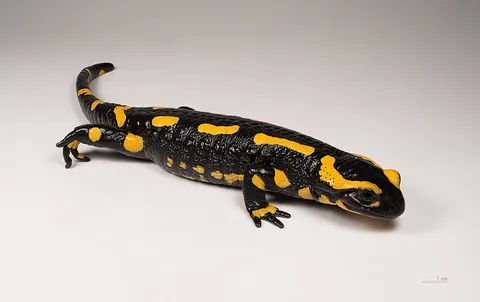
salamander noun: a long, slender, chiefly terrestrial amphibian of the order Caudata, superficially resembling a lizard.

Noun
salamander (countable and uncountable, plural salamanders)
- A long, slender, chiefly terrestrial amphibian of the order Caudata, superficially resembling a lizard.
- […]and most plainly Pierius, whose words in his hieroglyphicks are these: "Whereas it is commonly said that a salamander extinguisheth fire, we have found by experience that it is so far from quenching hot coals, that it dyeth immediately therein."1672, Thomas Browne, “Pseudodoxia Epidemica”, in Simon Wilkin, editor, The Works of Sir Thomas Browne, volume 1, published 1852, page 292
- Devils Lake is where I began my career as a limnologist in 1964, studying the lake’s neotenic salamanders and chironomids, or midge flies.[…]The Devils Lake Basin is an endorheic, or closed, basin covering about 9,800 square kilometers in northeastern North Dakota.2012 January, Douglas Larson, “Runaway Devils Lake”, in American Scientist, volume 100, number 1, archived from the original on 23 May 2012, page 46
- A creature much like a lizard that is resistant to and lives in fire (in which it is often depicted in heraldry), hence the elemental being of fire.
- “Not a chance, Ranger,” Bob Mason was speaking. “This little cuss is a salamander. He's been travelling through fire all day and there isn't a blister on him. …”1920, Peter B. Kyne, chapter XI, in The Understanding Heart
- "There is a vulgar error," says the author of the Brief Natural History, p. 91, "that a salamander lives in the fire. Yet both Galen and Dioscorides refute this opinion; and Mathiolus, in his Commentaries upon Dioscorides, a very famous physician, affirms of them, that by casting of many a...1849, John Brand, Observations on the Popular Antiquities of Great Britain: Chiefly Illustrating the Origin of Our Vulgar and Provincial Customs, Ceremonies, and Superstitions, volume 3, page 372
- A metal utensil with a flat head which is heated and put over a dish to brown the top.
- The salamander, a fairly long metal utensil with a flat rounded head, was left in the fire until red hot and then used to brown the top of a dish without further cooking.1977, Richard Daunton-Fear, Penelope Vigar, Australian Colonial Cookery (discussing 19th century cookery), Rigby, 1977, page 41
- A small broiler (North America) or grill (Britain) that heats the food from above, used in professional cookery primarily for browning.
- The chef first put the steak under the salamander to sear the outside.
- Overfired grills, or salamanders, can, in addition, be used for making toast and salamandering. They have the heat source above the food[…]. This may comprise sets of burners firing below refractory or metal frets, or surface combustion plaques.2006, Frank Saxon, editor, Tolley's Industrial and Commercial Gas Installation Practice [Gas Service Technology; 3], 4th edition, Oxford; Burlington, Mass.: Elsevier Newnes, →ISBN, page 35
- A pouched gopher (Geomys pinetis etc.)
- A large poker.
- Multitudes had little Tin Kettles in their Houses, with Small-coal kindled, to light their Pipes withal; though in some places they use Candles, in others Salamanders1698, William King, A journey to London […] , translation of original by Samuel Sorbière
- Solidified material in a furnace hearth.
- Salamander tapping is done at the salamander base, which is the bottom-most level of the liquid pool in a blast furnace hearth. A high degree of precision is required to tap the salamander base effectively2019, Ian Cameron, Mitren Sukhram, Kyle Lefebvre, Blast Furnace Ironmaking
- Synonyms:
- Shadrach
- A portable stove used to heat or dry buildings under construction.
- The necessary fires alone — the salamanders and tinner's pots — had caused dozens of small blazes.2003, Erik Larson, The Devil in the White City, Vintage Books, page 192
- A fire-eater (performer who pretends to swallow fire).
Verb
salamander (third-person singular simple present salamanders, present participle salamandering, simple past and past participle salamandered)
- To use a salamander (cooking utensil) in a cooking process.
- When cold, sprinkle the custard thickly with sugar and salamander it.19th century (quoted 1977), Richard Daunton-Fear, Penelope Vigar, Australian Colonial Cookery, Rigby, →ISBN, page 41
- Overfired grills, or salamanders, can, in addition, be used for making toast and salamandering. They have the heat source above the food […]. This may comprise sets of burners firing below refractory or metal frets, or surface combustion plaques.2006, Frank Saxon, editor, Tolley's Industrial and Commercial Gas Installation Practice [Gas Service Technology; 3], 4th edition, Oxford; Burlington, Mass.: Elsevier Newnes, →ISBN, page 35
salamander meaning in Hindi, Tamil, Urdu and Assamese
salamander in Hindi
- amphibian
- सैलामैंडर sailāmaiṇḍar
salamander in Tamil
- சாலமாண்டர்
salamander in Urdu
- آتش خوار
salamander in Assamese
- amphibian
- মাগুৰ ভেকুলী magur bhekuli, চেলামেণ্ডাৰ selamendar
More languagesFewer languages
- salamander in Tagalog
- bangkalang
- salamander in Arabic
- سَمَنْدَل samandal
- salamander in Malay
- semandar, salamander
- salamander in Indonesian
- salamander
- salamander in Persian
- سمندر samandar
- salamander in Thai
- ซาลาแมนเดอร์ saa-laa-mɛɛn-də̂ə
- salamander in Vietnamese
- kì giông, cá cóc
- salamander in Myanmar
- ဆလမန္ဒာကောင် hca.la.mandakaung
Examples of salamander in a sentence
- The cave was populated by albino scorpions, blind salamanders, and other troglodytes.
- Some salamanders are both gillless and lungless as adults, relying solely on cutaneous respiration to breathe.
- A salamander darted out of an opening in the rocks.
Synonyms of salamander
Forms of salamander
| Noun | |
|---|---|
| plural | salamanders |
| Verb | |
| third-person singular present | salamanders |
| present participle | salamandering |
| past participle | salamandered |
| past | salamandered |
Origin of salamander
From Middle English salamandre, from Anglo-Norman salamandre, from Latin salamandra, from Ancient Greek σαλαμάνδρα (salamándra), of uncertain origin (per Beekes, likely Pre-Greek); possibly of Iranian origin, see Persian سمندر (samandar) for more information.
Words formed from salamander
- Abe's salamander
- alpine salamander
- cave salamander
- fire salamander
- frogamander
- gerrymander
- giant salamander
- Japanese giant salamander
- klip-salamander
- Korean crevice salamander
- land-salamander
- Larch Mountain salamander
- limestone salamander
- longtail salamander
- lungless salamander
- marbled salamander
- mole salamander
- northern slimy salamander
- ravine salamander
- salamander cloth
- salamanderfish
- salamanderlike
- seal salamander
- spectacled salamander
- spotted salamander
- spring salamander
- Strinati's cave salamander
- tiger salamander
- water-salamander
- zigzag salamander
Phrases with salamander
Questions about salamander
- What does salamander mean?
- Salamander means a long, slender, chiefly terrestrial amphibian of the order Caudata, superficially resembling a lizard.
- What is salamander in Hindi?
- Salamander in Hindi is सैलामैंडर (sailāmaiṇḍar). See Salamander meaning in Hindi.
- What part of speech is salamander?
- Salamander can be a noun or a verb.
- How do you pronounce salamander?
- Salamander is pronounced /ˈsæləˌmændə/ (UK).
- What is the plural of salamander?
- The plural of salamander is salamanders.
Words near salamander in the dictionary
Source and license
Adapted from Wiktionary: salamander (page history and authors); salamander (Tamil Wiktionary) (page history and authors); salamander (Urdu Wiktionary) (page history and authors). Text available under the Creative Commons Attribution-ShareAlike 4.0 license. Word.ws reformatted the entry and added links. Wiktionary data of 2026-09-02.
Last updated:
Pronunciation audio from Wikimedia Commons, each file under its own free license: LL-Q1860 (eng)-Vealhurl-salamander.wav.
Cite this entry: “salamander.” Word.ws, https://word.ws/salamander. Based on Wiktionary, CC BY-SA 4.0.