
fray
/fɹeɪ/
fray verb: to rub or wear away (something); to cause (something made of strands twisted or woven together, such as cloth or rope) to unravel through friction; also, to irritate (something) through chafing or rubbing; to chafe.
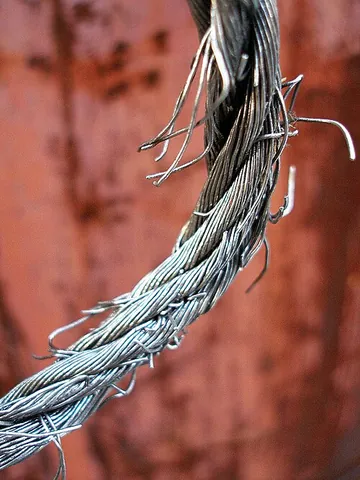

Verb (1)
fray (third-person singular simple present frays, present participle fraying, simple past and past participle frayed)
- To rub or wear away (something); to cause (something made of strands twisted or woven together, such as cloth or rope) to unravel through friction; also, to irritate (something) through chafing or rubbing; to chafe.
- S. Paul alſo defineth the law to be the knowlege of ſyn, yͭ is, which accuſeth, frayeth the cõſcience, & maketh ſynnes knowen.1538, Erasmus Sarcerius, “Of the Lawe of God”, in Richard Taverner, transl., Cõmon Places of Scripture Ordrely and after a Cõpendious Forme of Teachyng, Set Forth with No Litle Labour, […], London...
- [W]ith the help of her consorts, [she] carried off the following goods of her said lady; viz. […] four striped muslin night-rails very little frayed; […]1710 November 12 (Gregorian calendar), Isaac Bickerstaff [et al., pseudonyms; Richard Steele], “Wednesday, November 2, 1710”, in The Tatler, number 245; republished in [Richard Steele], editor, The...
- To force or make (a path, way, etc.) through.
- To bruise (someone or something); also, to take the virginity of (someone, usually a female person); to deflower.
- [T]his ſame Ladie Dryopee, the fayreſt Ladye tho / In all the land of Oechalye. Whom beeing then no mayd / (For why the God of Delos and of Delphos had her frayd) / Andræmon taketh too hys wyfe, and thinkes him well apayd.1567, Ovid, “The Ninth Booke”, in Arthur Golding, transl., The XV. Bookes of P. Ouidius Naso, Entytuled Metamorphosis, […], London: […] Willyam Seres […], →OCLC, folio 115, verso
- To become unravelled or worn; to unravel.
- Synonyms:
- frazzle
- To rub.
- Another distance, I do not know how far, of dry dark heather continually fraying against my knees, is traversed, when in front appears a coombe, overgrown with heather from summit to foot, and I stop suddenly.1884, Richard Jefferies, “Wild Exmoor”, in Red Deer, London: Longmans, Green, and Co., →OCLC, page 29
- Synonyms:
- frazzle
- Of a deer: to rub its antlers against a tree, etc., to remove the velvet or to mark territory.
- His [a hart's] head when it commeth firſt out, hath a ruſſet pyll vpon it, the which is called Veluet,[…]. When his head is growne out to the full bigneſſe, then he rubbeth of that pyll, and that is called fraying of his head.1575, Jacques du Fouilloux, “Of the Termes of Venery”, in George Gascoigne, transl., The Noble Art of Venerie or Hunting. […], London: […] Thomas Purfoot, published 1611, →OCLC, page 244
- And foresters have busy been, / To track the buck in thicket green; / […] / We can shew the marks he made, / When ’gainst the oak his antlers fray’d; […]1820, Walter Scott, “[Miscellaneous Poems.] Hunting Song”, in The Poetical Works of Walter Scott, Esq. […], volume XII, Edinburgh: […] [James Ballantyne and Company] for Arch[ibald] Constable and...
- Of a person's mental strength, nerves, temper, etc.: to become exhausted or worn out.
- The hectic day ended in her nerves frayed.
- Synonyms:
- frazzle
Noun (1)
fray (plural frays)
- A consequence of rubbing, unravelling, or wearing away; a fraying; also, a place where fraying has occurred.
- The laces frayed at the cut end.
- "And pray, sir, what do [you] think of Miss Morland's gown?" / "It is very pretty, madam," said he, gravely examining it; "but I do not think it will wash well; I am afraid it will fray."1803 (date written), [Jane Austen], chapter III, in Northanger Abbey; published in Northanger Abbey: And Persuasion. […], volume I, London: John Murray, […], 20 December 1817 (indicated as 1818)...
- Synonyms:
- frazzle
Verb (2)
fray (third-person singular simple present frays, present participle fraying, simple past and past participle frayed)
- To alarm or frighten (someone or something).
- VVhy Dame (quoth he) vvhat hath ye thus diſmayd? / VVhat frayes ye, that vvere vvont to comfort me affrayd?1590, Edmund Spenser, “Book I, Canto I”, in The Faerie Queene. […], London: […] [John Wolfe] for William Ponsonbie, →OCLC, stanza 52, page 18
- But ſoone as they approcht vvith deadly threat, / The Palmer ouer them his ſtaffe vpheld, / […] Inſtead of fraying, they them ſelues did feare, / And trembled, as them paſſing they beheld: / Such vvondrous povvre did in that ſtaffe appeare, / All monſters to ſubdevv to him, that did it beare.1590, Edmund Spenser, “Book II, Canto XII”, in The Faerie Queene. […], London: […] [John Wolfe] for William Ponsonbie, →OCLC, stanza 40, page 373
- Often followed by away, off, or out: to frighten or scare (someone or something) away.
- VVhat, are the turtles fraid out of their neaſts?c. 1587–1588 (date written), [Christopher Marlowe], Tamburlaine the Great. […] The First Part […], 2nd edition, part 1, London: […] [R. Robinson for] Richard Iones, […], published 1592, →OCLC...
- And the carkeiſes of this people ſhall be meate for the fowles of the heauen, and for the beaſts of the earth, and none ſhall fray them away.1611, The Holy Bible, […] (King James Version), London: […] Robert Barker, […], →OCLC, Jeremiah 7:33, column 1
- Synonyms:
- affray
- To assail or attack (someone or something); to drive (someone or something) away by attacking.
- To chase (someone or something) away; to disperse.
- And this is it, that frayeth men from Chriſt, becauſe they are loath to vunder go his burthen and yoke, to caſt of the world, & leuing thẽſeluen behind thẽ to follow Chriſt.1583, Bartimeus Andreas [i.e., Bartimaeus Andrewes], “Canticles. 6.”, in Certaine Verie Worthie, Godly and Profitable Sermons, upon the Fifth Chapiter of the Songs of Solomon: […], London: […] Robert...
- Svveet Phoſpher bring the day, / Thy light vvill fray / Theſe horrid Miſts; […]1635, Fra[ncis] Quarles, “Canto XIV. Psal[m] XIII. III.”, in Emblemes, London: […] G[eorge] M[iller] and sold at at Iohn Marriots shope […], →OCLC, book I, stanza 2, page 57
- To be afraid or frightened; to fear.
- To make an assault or attack; also, to create a disturbance; to brawl, to fight.
- Then next is the Clinke, a Goale or Priſon for the Treſpaſſers in thoſe parts, namely, in old time for ſuch as ſhould brabble, fray, or break the peace on the ſaid Bank, or in the Brothel Houſes; […]1657, Jam. Howel [i.e., James Howell], “Of the Twenty Sixth, or the Last Ward of the City of London, Called the Bridge-ward Without, Containing the Bourough of Southwark”, in Londinopolis; an...
Noun (2)
fray (countable and uncountable, plural frays)
- A noisy commotion, especially resulting from fighting; a brawl, a fight; also, a loud quarrel.
- Though they did not know the reason for the dispute, they did not hesitate to leap into the fray.
- Pry[nce]: VVhere be the vile beginners of this fray? / Ben[volio]: Ah Noble Prince I can diſcouer all / The moſt vnlucky mannage of this bravvle. / […] Pry: Speake Benuolio vvho began this fray? / Ben: Tibalt heere ſlaine vvhom Romeos hand did ſlay.c. 1591–1595 (date written), [William Shakespeare], […] Romeo and Juliet. […] (First Quarto), London: […] Iohn Danter, published 1597, →OCLC, [Act III, scene i]
- A heated argument; a war of words.
- Conflict, disagreement.
- It is the chafing of the lion, and the stirring of the viper, that aggravates the danger; the first blow makes the wrong, but the second makes the fray; and they that will endure no kind of abuse in state or church, are many times more dangerous than that abuse which they oppose.a. 1632 (date written), John Donne, “Sermon XCIX. Preached at Lincoln’s Inn. The Second Sermon on Matthew xviii. 7.”, in Henry Alford, editor, The Works of John Donne, D.D., […], volume IV, London...
- [W]hen the conteſt is by the proud Man againſt the humble Man, the ſtrife is quickly at an end: it is a true Proverb, It is the ſecond blovv makes the fray: the humble Man gives vvay to the vvrath and inſolence of the proud Man, and thereby ends the quarrel; for Yielding pacifieth vvrath, ſaith the...1676, [Matthew Hale], “Of Humility, Its Opposite Vices, Benefits, & Means to Acquire It”, in Contemplations Moral and Divine. […], London: […] William Godbid, for William Shrowsbury […], and John...
- An assault or attack.
- Synonyms:
- affray
- A loud noise; a cacophony, a din.
- Where window is open, cat maketh a fray, / yet wilde cat with two legs is worse by my fay.1878, Thomas Tusser, “Huswifely Admonitions”, in Five Hundred Pointes of Good Husbandrie. […], London: Published for the English Dialect Society by Trübner & Co., […], →OCLC; republished as W[illiam]...
- Fright, terror; (countable) an instance of this.
- Thus that fray vvas over, and vve came aſhore again: recovered of the fright vve had been in.1699, William Dampier, “The Country of Achin Described: […]”, in Voyages and Descriptions. Vol. II. […], London: […] James Knapton, […], →OCLC, part I (His Voyage from Achin in Sumatra, to Tonquin...
- Synonyms:
- affray
Verb (3)
fray (third-person singular simple present frays, present participle fraying, simple past and past participle frayed)
- To bear the expense of (something); to defray.
- [T]he charge of my moſt curious, and coſtly ingredients fraide, amounting to ſome ſeaventeene thouſand crovvnes, a trifle in reſpect of health, vvriting your noble name in my Catalogue, I ſhall acknovvledge my ſelfe amply ſatisfi'd.1631 (first performance), Philip Massinger, The Emperour of the East. A Tragæ-comœdie. […], London: […] Thomas Harper, for Iohn Waterson, published 1632, →OCLC, Act IV, scene iii
Proper noun capitalized: Fray
Fray (plural Frays)
- A surname.
fray meaning in Tamil, Urdu, Bengali and Malayalam
fray in Tamil
- சண்டை, நலிவுண்டாக்கு, பிணக்கு, போட்டி
fray in Urdu
- ہنگامہ, لڑائی
fray in Bengali
- ঝগড়া, দাঙ্গা, কোলাহলপূর্ণ যুদ্ধ, বিবাদ
fray in Malayalam
- ഉരുമ്മുക, ഉരയുക, തേഞ്ഞുകീറുക, തേയുക
More languagesFewer languages
- fray in Kannada
- ಕಾದಾಟ, ಹೋರಾಟ, ಪೋರ್ತ, ಹೊಯಿಕುಟ್ಟು
Examples of fray in a sentence
- Everything told of long use and quiet slow decay; the very bell-rope in the porch was frayed into a fringe, and hoary with old age.1840 April – 1841 November, Charles Dickens, “Chapter the Seventeenth”, in The Old Curiosity Shop. A Tale. […], volume I, London: Chapman...
- It was a little past mid-day when the four-horse stage-coach by which I was a passenger, got into the ravel of traffic frayed out about the Cross-Keys, Wood-street, Cheapside, London.1860 December – 1861 August, Charles Dickens, chapter I, in Great Expectations […], volume III, London: Chapman and Hall, […], published...
- They are then fraying, rubbing the velvet off their new horns against the trees.1884, Richard Jefferies, “Tracking Deer by Slot”, in Red Deer, London: Longmans, Green, and Co., →OCLC, page 112:
- [T]here's no woman made without a flaw; / Your purest lawns have frays, and cambrics bracks.c. 1613 (date written; published 1630), Thomas Middleton, “A Chaste Maid in Cheapside”, in A[rthur] H[enry] Bullen, editor, The Works of...
Synonyms of fray
Forms of fray
| Verb | |
|---|---|
| third-person singular present | frays |
| present participle | fraying |
| past participle | frayed |
| past | frayed |
| second-person singular present (archaic) | frayest |
| second-person singular past (archaic) | frayedst |
| third-person singular present (archaic) | frayeth |
| Noun | |
| plural | frays |
Origin of fray
The verb is derived from Late Middle English fraien (“to beat so as to cause bruising, to bruise; to crush; to rub; to wear, wear off”), borrowed from Old French fraier, freier, freiier (modern French frayer (“to clear, open up (a path, etc.); (figuratively) to find one’s way through (something); (obsolete) to rub”)), from Latin fricāre, the present active infinitive of fricō (“to chafe; to rub”), an intensive form of friō (“to break into pieces, crumble; to rub”), ultimately from Proto-Indo-European *bʰreyH- (“to cut”). Sense 1.2 (“to force or make (a path, way, etc.) through”) is derived from modern French frayer: see above. The noun is derived from the verb.
From Late Middle English fraien (“to attack, invade; to make an attack; to brawl, fight; to make a loud noise (?); to frighten, terrify; to be frightened of (something), fear”), an aphetic variant of affraien (“to attack, invade; to harass; to brawl, fight; to riot; to reproach; to frighten, terrify; to be frightened of (something), fear; to alarm, disturb; to arouse, awaken, excite”) (whence affray), from Anglo-Norman affraier, afrayer (“to frighten, terrify; to disquiet; to disturb”) [and other forms], a variant of effreier, esfreier [and other forms], and Old French effreer, esfreer (“to frighten, scare; to be afraid”) [and other forms] (modern French effrayer), from Vulgar Latin *exfridāre, from Latin ex- (prefix indicating privation) + Frankish *friþu (“peace”) (from Proto-Germanic *friþuz (“peace, tranquility; refuge, sanctuary”), ultimately from Proto-Indo-European *preyH- (“to love; to please”)).
From Late Middle English frai (“an assault, attack; a brawl, fight; disturbance, uproar; fine for assault or breach of the peace”), an aphetic variant of affrai, effrai (“an assault, attack; a brawl, fight; disturbance, uproar; public disturbance, riot; dismay; fear; something frightening”), then: * from affraien (verb); and * from Anglo-Norman affrai, affrei [and other forms], a variant of effray, effrei, esfrei, esfroi, Middle French effray, esfroi, and Old French effrei, esfrei, esfroi (“breach of the peace, disturbance; noise; dread, terror”) (modern French effroi (“(literary) dread, terror”)), from Old French effreer, esfreer (verb). See further at etymology 2.
Words formed from fray
Phrases with fray
Words that rhyme with fray
Questions about fray
- What does fray mean?
- Fray means to rub or wear away (something); to cause (something made of strands twisted or woven together, such as cloth or rope) to unravel through friction; also, to irritate (something) through chafing or rubbing; to chafe.
- What is fray in Tamil?
- Fray in Tamil is சண்டை, நலிவுண்டாக்கு, பிணக்கு. See Fray meaning in Tamil.
- How do you use fray in a sentence?
- Everything told of long use and quiet slow decay; the very bell-rope in the porch was frayed into a fringe, and hoary with old age.
- What part of speech is fray?
- Fray can be a verb, a noun or a proper noun.
- How do you pronounce fray?
- Fray is pronounced /fɹeɪ/ (UK).
- What is the past tense of fray?
- The past tense of fray is frayed.
Words near fray in the dictionary
Source and license
Adapted from Wiktionary: fray (page history and authors); Fray (page history and authors); fray (Tamil Wiktionary) (page history and authors); fray (Urdu Wiktionary) (page history and authors); Fray (Bengali Wiktionary) (page history and authors); fray (Malayalam Wiktionary) (page history and authors); fray (Kannada Wiktionary) (page history and authors). Text available under the Creative Commons Attribution-ShareAlike 4.0 license. Word.ws reformatted the entry and added links. Wiktionary data of 2026-09-02.
Last updated:
Pronunciation audio from Wikimedia Commons, each file under its own free license: LL-Q1860 (eng)-Vealhurl-fray.wav.
Cite this entry: “fray.” Word.ws, https://word.ws/fray. Based on Wiktionary, CC BY-SA 4.0.