
lew
/ljuː/
lew noun: a French gold coin circulated in 15th-century Scotland. Also the alternative form of lo or look.
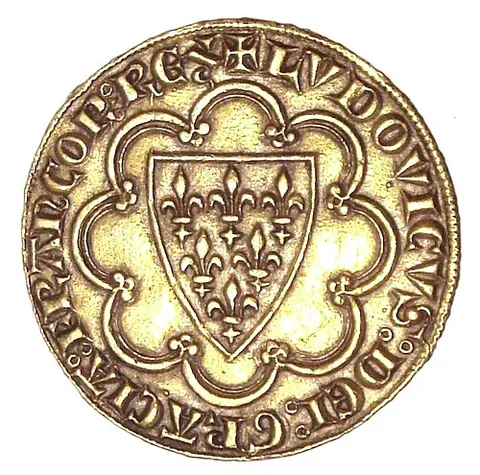

Noun (1)
Adjective (1)
Noun (2)
lew (plural lews)
- Warmth, heat.
- To th' end a fruitfull lew
May euerie Climate in his time renew.1605, J. Sylvester translating G. de S. Du Bartas as Deuine Weekes & Wks, Book i, Ch. iv, p. 136
- To th' end a fruitfull lew
- A shelter from the wind, particularly temporary structures raised by shepherds to protect their flocks.
- Lew, shelter; defence from storms or wind.1825, J. Jennings, Observ. Dial. W. Eng., p. 52
- Lew, a thatched hurdle, supported by sticks, and set up in a field to screen lambs, etc. from the wind.1887, W. D. Parish & al., Dictionary of the Kentish Dialect
Verb
lew (third-person singular simple present lews, present participle lewing, simple past and past participle lewed)
Adjective (2)
lew (comparative more lew, superlative most lew)
Proper noun capitalized: Lew
Lew (plural Lews)
- A diminutive of the male given name Lewis.
- A male given name.
- When Lew Wasserman reinvented the studio system, leadership skills grew harder to find and the number of modern studio conglomerates boiled down to six, as discussed in chapters 15 to 20.2019, Douglas Gomery, The Hollywood Studio System: A History, Bloomsbury Publishing, →ISBN
- A male given name.
- A surname.
Also used as
lew is also the alternative form of lo or look.
lew is also the alternative form of lue.
Forms of lew
| Noun | |
|---|---|
| plural | lews |
| plural | lewis |
| plural | leois |
| alternative form | lewe |
| Adjective | |
| comparative | lewer |
| superlative | lewest |
| alternative form | lue |
| alternative form | loo |
| alternative form | looe |
| alternative form | lee |
| comparative | more lew |
| superlative | most lew |
| Verb | |
| third-person singular present | lews |
| present participle | lewing |
| past participle | lewed |
| past | lewed |
Origin of lew
From corruption of French louis, from Louis, presumably Louis IX or Louis XI, who issued gold écus.
From Middle English lew, lewe, from Old English *hlēowe, *hlīewe (attested adverbially in hlēowe (“warmly”) and as ġehlēowe, ġehlīewe (“warm, sunny, sheltered”), unhlēowe (“not warm, chill”)), from Proto-West Germanic *hliwi, from Proto-Germanic *hliwjaz, *hlēwaz (“warm, lukewarm”), from Proto-Indo-European *ḱal(w)e-, *ḱlēw- (“warm, hot”). Cognate with Old Norse hlýr (“warm, mild”), ( > Danish ly (“lukewarm”)), hlær, German lau, which are themselves akin to Old Norse hlé (“lee”), Danish læ (“shelter”). Compare lee.
Uncertain, but compare Old English ġelewed (“weakness, infirmity”) and limlǣweo (“limb-weak, lame”). Possibly related to Proto-Germanic *laiwą (“damage”); compare Old Norse læ (“venom, bane”).
Words formed from lew
Phrases with lew
Words that rhyme with lew
Questions about lew
- What does lew mean?
- Lew means a French gold coin circulated in 15th-century Scotland.
- What part of speech is lew?
- Lew can be a noun, an adjective, a verb or a proper noun.
- How do you pronounce lew?
- Lew is pronounced /ljuː/.
- What is the plural of lew?
- The plural of lew is lews.
Words near lew in the dictionary
Source and license
Adapted from Wiktionary: lew (page history and authors); Lew (page history and authors). Text available under the Creative Commons Attribution-ShareAlike 4.0 license. Word.ws reformatted the entry and added links. Wiktionary data of 2026-09-02.
Last updated:
Pronunciation audio from Wikimedia Commons, each file under its own free license: LL-Q1860 (eng)-Vealhurl-lew.wav.
Cite this entry: “lew.” Word.ws, https://word.ws/lew. Based on Wiktionary, CC BY-SA 4.0.