
pulse
UK/pʌls//pʌls/
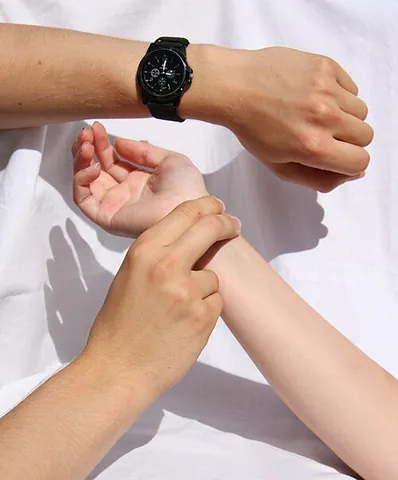
pulse noun: a normally regular beat felt when arteries near the skin (for example, at the neck or wrist) are depressed, caused by the heart pumping blood through them; the qualitative nature of this beat.

Noun (1)
pulse (plural pulses)
- A normally regular beat felt when arteries near the skin (for example, at the neck or wrist) are depressed, caused by the heart pumping blood through them; the qualitative nature of this beat.
- Her pulse was thready and weak.
- The rate of this beat as an indication of a person's health.
- Her pulse was 110 at 8 a.m.
- [A] Pulſe which is ſlow and large denotes ſufficient remains of ſtrength, tenſion, and thickneſs of the fibres of the heart and arteries, and a viſcid and tenacious blood. All unequal Pulſes are very bad, ſince they denote that there is neither a due influx of the ſpirits, nor a proper and equal...1764, “№ XXVII. A Dissertation on the Pulse, and the Dijudication Drawn therefrom.”, in The Medical Museum: Or, A Repository of Cases, Experiments, Researches, and Discoveries Collected at Home and...
- Synonyms:
- heart rate, HR
- A beat or throb; also, a repeated sequence of such beats or throbs.
- When the ear receives any ſimple ſound, it is ſtruck by a ſingle pulſe of the air, which makes the ear-drum and the other membranous parts vibrate according to the nature and ſpecies of the ſtroke.1756 (date written), [Edmund Burke], “Sect. XI. The Artificial Infinite.”, in A Philosophical Enquiry into the Origin of Our Ideas of the Sublime and Beautiful, London: […] R[obert] and J[ames]...
- I roved at random through the town, / [...] / And caught once more the distant shout, / The measured pulse of racing oars / Among the willows; [...]1850, [Alfred, Lord Tennyson], “Canto LXXXV”, in In Memoriam, London: Edward Moxon, […], →OCLC, page 125
- The focus of energy or vigour of an activity, place, or thing; also, the feeling of bustle, busyness, or energy in a place; the heartbeat.
- You can really feel the pulse of the city in this district.
- An (increased) amount of a substance (such as a drug or an isotopic label) given over a short time.
- A setting on a food processor which causes it to work in a series of short bursts rather than continuously, in order to break up ingredients without liquidizing them; also, a use of this setting.
- The beat or tactus of a piece of music or verse; also, a repeated sequence of such beats.
- A brief burst of electromagnetic energy, such as light, radio waves, etc.
- A thin ruby crystal is illuminated by two successive intense short pulses of coherent light, t seconds apart, obtained from a ruby-laser source. As expected, the crystal will transmit the two pulses t seconds apart. But then one observes a curious additional feature: a third light pulse emerges...1969, “[Scientific Progress in F[iscal] Y[ear] 69: Electronics] The Photon Echo”, in Jacob Seiden, editor, OAR Progress for 1969 (OAR 69-0017; AD 699300), Arlington, Va.: Office of Aerospace...
- Synonym of autosoliton (“a stable solitary localized structure that arises in nonlinear spatially extended dissipative systems due to mechanisms of self-organization”).
- Synonyms:
- autosoliton
- A brief increase in the strength of an electrical signal; an impulse.
- A timed, coordinated connection, when multiple public transportation vehicles are at a hub at the same time so that passengers can flexibly connect between them.
Verb
pulse (third-person singular simple present pulses, present participle pulsing, simple past and past participle pulsed)
- To emit or impel (something) in pulses or waves.
- Though a light of love she swimmeth, / Zoned with utterless desire, / And the air of her swift coming / Through thy hot veins pulseth fire.1850, W[illiam] C[ox] Bennett, “The Shadow-hunted”, in Poems, London: Chapman and Hall, […], →OCLC, page 139
- Rapidly rotating dead stars, pulsars are so named because as they spin, they release beams of electromagnetic radiation across space that appear to pulse like celestial lighthouses.2023 August 30, Ashley Strickland, “Astronomers solve the puzzle of an unusual pulsing dead star”, in CNN
- To give to (something, especially a cell culture) an (increased) amount of a substance, such as a drug or an isotopic label, over a short time.
- To operate a food processor on (some ingredient) in short bursts, to break it up without liquidizing it.
- To apply an electric current or signal that varies in strength to (something).
- To manipulate (an electric current, electromagnetic wave, etc.) so that it is emitted in pulses.
- To expand and contract repeatedly, like an artery when blood is flowing though it, or the heart; to beat, to throb, to vibrate, to pulsate.
- Hot blood pulsed through my veins as I grew angrier.
- The streets were dark, and all that could be seen was light pulsing from the disco.
- Synonyms:
- undulate
- Of an activity, place, or thing: to bustle with energy and liveliness; to pulsate.
- There is a dangerous censoriousness pulsing through American society. In small towns and big cities alike, would-be commissars are fighting, in the name of a distinct minority of Americans, to stifle open discussion and impose their views on the community at large. Dissenters, when they speak out...2022 February 18, Jamelle Bouie, “Opinion: You Just Can’t Tell the Truth About America Anymore”, in The New York Times, New York, N.Y.: The New York Times Company, →ISSN, →OCLC, archived from the...
- The emotion had pulsed from the outset, the Ukraine players emerging from the tunnel with blue and yellow flags around their shoulders; the rendition of their anthem seeing eyes well up.2023 March 26, David Hytner, “Kane and Bukayo Saka combine against Ukraine for England’s perfect Euros start”, in The Guardian
Noun (2)
pulse (countable and uncountable, plural pulses)
- Annual leguminous plants (such as beans, lentils, and peas) yielding grains or seeds used as food for humans or animals; (countable) such a plant; a legume.
- Wild nuts, peas, vetch, a legume which had edible seed pods, and grasses were often combined with pulses like beans or lentils, the most commonly identified ingredient, and at times, wild mustard. To make the plants more palatable, pulses, which have a naturally bitter taste, were soaked, coarsely...2022 November 22, Katie Hunt, “Neanderthals cooked meals with pulses 70,000 years ago”, in CNN
- Edible grains or seeds from leguminous plants, especially in a mature, dry condition; (countable) a specific kind of such a grain or seed.
pulse meaning in Hindi, Tamil, Marathi and Urdu
pulse in Hindi
- normally regular beat felt when arteries near the skin are depressed, caused by the heart pumping blood through them
- नाड़ी nāṛī, नब्ज़ nabz
- annual leguminous plants yielding grains or seeds used as food for humans or animals; such a plant — see also legume
- दलहन dalhan, दाल dāl
- edible grains or seeds from leguminous plants; specific kind of such a grain or seed
- दलहन dalhan, दाल dāl
pulse in Tamil
- நாடி, துடிப்பு, பருப்பு, பருப்பு வகை தானியங்கள்
pulse in Marathi
- नाडी, पल्स
pulse in Urdu
- normally regular beat felt when arteries near the skin are depressed, caused by the heart pumping blood through them
- ناڑی nāṛī, نبض nabz, دھڑکن dhaṛkan
More languagesFewer languages
- pulse in Bengali
- নাড়ি naṛi, স্পন্দন spondon
- pulse in Telugu
- పప్పుధాన్యము pappudhānyamu, నాడి nāḍi, ధాతువు dhātuvu
- pulse in Malayalam
- പയർ, പയർവഗ്ഗങ്ങൾ, നവധാന്യം, പട്ടാണിപ്പയറ്
- pulse in Kannada
- ಮಿಡಿತ, ಹೊಡೆತ, ಗುಕ್ಕು, ಎದೆಬಡಿತ
- pulse in Punjabi
- ਨਬਜ਼ nabz, ਨਾੜ nāṛ
- pulse in Gujarati
- પલ્સ
- pulse in Odia
- ପଲ୍ସ
- pulse in Sanskrit
- नाडी nāḍī́
- pulse in Nepali
- पल्स, नाडी, पल्स्स
- pulse in Pashto
- نبض nabz
- pulse in Tagalog
- pulso
- pulse in Arabic
- نَبْض nabḍ, نَبْضَة nabḍa
- pulse in Malay
- nadi, detik
- pulse in Indonesian
- pulsa, nadi
- pulse in Persian
- نبض nabz, تپ tap
- pulse in Thai
- ชีพจร chîip-pá-jɔɔn
- pulse in Vietnamese
- mạch
Examples of pulse in a sentence
- [A] Pulſe which is ſlow and large denotes ſufficient remains of ſtrength, tenſion, and thickneſs of the fibres of the heart and arteries, and a viſcid and tenacious blood.1764, “№ XXVII. A Dissertation on the Pulse, and the Dijudication Drawn therefrom.”, in The Medical Museum: Or, A Repository of Cases...
- [M]y experience is that men may enjoy better health, do more work, have clearer brains, a steadier pulse, and go on to old age better without alcohol than with.1870 May 21, Thomas Cash, “United Kingdom Band of Hope Union. Annual Conference.”, in The Temperance Record. The Organ of the National...
- A thin ruby crystal is illuminated by two successive intense short pulses of coherent light, t seconds apart, obtained from a ruby-laser source.1969, “[Scientific Progress in F[iscal] Y[ear] 69: Electronics] The Photon Echo”, in Jacob Seiden, editor, OAR Progress for 1969 (OAR...
- As pulseth in thy northern skies / Th' Aurora—so, in ecstasies, / Through starry maze, my spirit flies; [...]1849, A[ndrew] J[ames] Symington, “To Mademoiselle Jenny Lind”, in Harebell Chimes: Or Summer Memories and Musings, London: Houlston and...
Synonyms of pulse
Forms of pulse
| Noun | |
|---|---|
| plural | pulses |
| Verb | |
| third-person singular present | pulses |
| present participle | pulsing |
| past participle | pulsed |
| past | pulsed |
Origin of pulse
From Late Middle English pulse, Middle English pous, pouse (“regular beat of arteries, pulse; heartbeat; place on the body where a pulse is detectable; beat (of a musical instrument); energy, vitality”) [and other forms], from Anglo-Norman puls, pous, pus, and Middle French pouls, poulz, pous [and other forms], Old French pous, pulz (“regular beat of arteries; place on the body where a pulse is detectable”) (modern French pouls), and from their etymon Latin pulsus (“beat, impulse, pulse, stroke; regular beat of arteries or the heart”), from pellō (“to drive, impel, propel, push; to banish, eject, expel; to set in motion; to strike”) (ultimately from Proto-Indo-European *pel- (“to beat, strike; to drive; to push, thrust”)) + -sus (a variant of -tus (suffix forming action nouns from verbs)).
From Late Middle English pulse, Middle English pulsen (“to pulse, throb”), from Latin pulsāre, the present active infinitive of pulsō (“to push; to beat, batter, hammer, strike; to knock on; (figuratively) to drive or urge on, impel; to move; to agitate, disquiet, disturb”), the frequentative of pellō (“to drive, impel, propel, push; to banish, eject, expel; to set in motion; to strike”); see further at etymology 1. Doublet of push.
From Middle English puls (“(collectively) seeds of a leguminous plant used as food; leguminous plants collectively; a species of leguminous plant”), Early Middle English pols (in compounds), possibly from Anglo-Norman pus, puz, Middle French pouls, pols, pous, and Old French pous, pou (“gruel, mash, porridge”) (perhaps in the sense of a gruel made from pulses), or directly from their etymon Latin puls (“meal (coarse-ground edible part of various grains); porridge”), probably from Ancient Greek πόλτος (póltos, “porridge made from flour”), from Proto-Indo-European *pel- (“dust; flour”) (perhaps by extension from *pel- (“to beat, strike; to drive; to push, thrust”), in the sense of something beaten).
Words formed from pulse
- aeropulse
- afterpulse
- anthropulse
- apulse
- a pussy and a pulse
- attopulse
- chirped-pulse amplification
- electromagnetic pulse
- electropulse
- finger on the pulse
- have one's finger on the pulse
- have one's fingers on the pulse
- interpulse
- intrapulse
- macropulse
- micropulse
- monopulse
- multipulse
- nanopulse
- nonpulse
- nuclear magnetic pulse
- nuclear-pulse rocket
- overpulse
- oxygen pulse
- photopulse
- postpulse
- prepulse
- pulsable
- pulsate
- pulsebeat
- pulse decay time
- pulse demodulator
- pulse detonation engine
- pulse diagnosis
- pulse dialing
- pulse dialling
- pulseful
- pulse glass
- pulsejet
- pulse jet
- pulseless
- pulselike
- pulse-like
- pulse modulation
- pulse modulator
- pulse ox
- pulse oximeter
- pulse oximetric
- pulse oximetry
- pulse-pounding
- pulse pressure
- pulse repetition time
- pulsetrain
- pulse wave
- pulsewidth
- pulsific
- pulsimeter
- pulsometer
- quadripulse
- subpulse
Phrases with pulse
Words that rhyme with pulse
Questions about pulse
- What does pulse mean?
- Pulse means a normally regular beat felt when arteries near the skin (for example, at the neck or wrist) are depressed, caused by the heart pumping blood through them; the qualitative nature of this beat.
- What is pulse in Hindi?
- Pulse in Hindi is नाड़ी (nāṛī), नब्ज़ (nabz), दलहन (dalhan). See Pulse meaning in Hindi.
- How do you use pulse in a sentence?
- [A] Pulſe which is ſlow and large denotes ſufficient remains of ſtrength, tenſion, and thickneſs of the fibres of the heart and arteries, and a viſcid and tenacious blood.
- What part of speech is pulse?
- Pulse can be a noun or a verb.
- How do you pronounce pulse?
- Pulse is pronounced /pʌls/ (UK).
- What is the plural of pulse?
- The plural of pulse is pulses.
Words near pulse in the dictionary
Source and license
Adapted from Wiktionary: pulse (page history and authors); pulse (Tamil Wiktionary) (page history and authors); pulse (Marathi, IndicTrans2 machine translation) (model and license); ధాతువు (Telugu) (page history and authors); pulse (Olam, E.K. Kurup corpus) (dataset and license); pulse (Kannada Wiktionary) (page history and authors); ਨਬਜ਼ (Punjabi) (page history and authors); pulse (Gujarati, IndicTrans2 machine translation) (model and license); pulse (Odia, IndicTrans2 machine translation) (model and license); नाडी (Sanskrit) (page history and authors); pulse (Nepali, IndicTrans2 machine translation) (model and license). Text available under the Creative Commons Attribution-ShareAlike 4.0 license. Word.ws reformatted the entry and added links. Wiktionary data of 2026-09-02.
Last updated:
Pronunciation audio from Wikimedia Commons, each file under its own free license: En-us-pulse.ogg.
Cite this entry: “pulse.” Word.ws, https://word.ws/pulse. Based on Wiktionary, CC BY-SA 4.0.