
fang
/ˈfæŋ/US/ˈfeɪ̯ŋ/
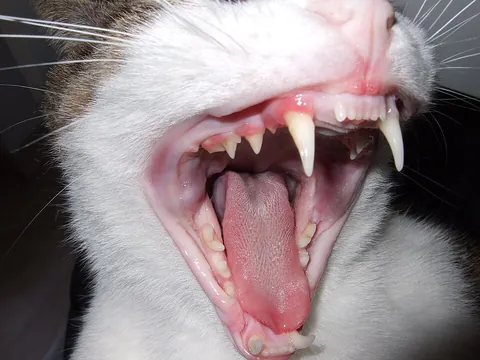
fang noun: a long, pointed canine tooth used for biting and tearing flesh.

Noun (1)
fang (plural fangs)
- A long, pointed canine tooth used for biting and tearing flesh.
- The warrior realized in an instant that he owed his life to this strange white man, and he also saw that only a miracle could save his preserver from those fierce yellow fangs that had been so near to his own flesh.1913, Edgar Rice Burroughs, The Return of Tarzan, New York: Ballantine Books, published 1963, page 123
- Synonyms:
- fangtooth
- Synonym of mandible, the long mouthpart of insects and other invertebrates.
- Synonyms:
- mandible
- A long, pointed tooth in snakes, used for injecting venom.
- A pointed extension of the chelicera in spiders, used for injecting venom.
- Synonym of tooth, particularly in humans.
- Synonyms:
- tooth, particularly in humans
- Either of the two factors that make a number a vampire number.
Verb (1)
fang (third-person singular simple present fangs, present participle fanging, simple past and past participle fanged)
Verb (2)
fang (third-person singular simple present fangs, present participle fanging, simple past and past participle fanged)
- To catch, capture; seize.
- Gentlemen, break not the head of the peace: it's to no purpose, for he's in the law's clutches; you see he's fanged.1605, John Webster, Northward Ho, act 1, scene 2
- Destruction fang mankind.c. 1605–1606, William Shakespeare, Timon of Athens, act 4, scene 3
- To take; receive with assent; accept.
- To receive with hospitality.
- To receive.
- To receive or adopt into spiritual relation, as in baptism; be godfather or godmother to.
Noun (2)
fang (plural fangs)
- A grasping; capture; the act or power of seizing; hold.
- That which is seized or carried off; booty; spoils; stolen goods.
- Synonyms:
- booty
- Synonym of trap or noose.
- Synonyms:
- trap or noose
- Synonym of root, the part of a tooth embedded in the gums.
- Synonyms:
- root
- Synonym of root, a major projection of a plant's root system.
- Now take out your Indian Tuberoſes, parting the Off-ſets (but with care, leſt you break their fangs) then pot them in natural (not forc'd) Earth; [...] the protuberant fangs of the Yuca are to be treated like the Tuberoſes.1669, John Evelyn, “Kalendarium Hortense: OrThe Gard’ners Almanac; […] [April.]”, in Sylva, or A Discourse of Forest-trees and the Propagation of Timber in His Majesties Dominions. […], 3rd edition...
- Synonyms:
- root
- Synonym of claw or talon.
- Synonyms:
- claw or talon
- Synonym of spike or prong, any sharp projection.
- Synonyms:
- spike or prong, any sharp projection
- Synonym of tang, the projection of a piece of metal intended to be driven into a shaft for holding.
- Synonyms:
- tang
- Synonym of vang, a line extended from the end of a gaff to control its position.
- Synonyms:
- vang
- The valve of a pump-box.
- A channel cut or pipe set for the purpose of carrying fresh air to working miners.
- Catches on which a coalmining cage rests while cars are being moved on and off.
- Synonyms:
- cage-shuts
Verb (3)
fang (third-person singular simple present fangs, present participle fanging, simple past and past participle fanged)
- To supply (a pump) with the water necessary for it to operate.
Verb (4)
fang (third-person singular simple present fangs, present participle fanging, simple past and past participle fanged)
- To drive, ride, etc. at high speed or recklessly.
- Soph was probably out drag-racing with Draz, or fanging down some brightly lit street somewhere hanging out Draz's brother's sunroof and waving at passers-by and screaming.2008, Mardi McConnochie, “The Mission”, in Dangerous Games
- The question of whether rail might be a better long-term option than road is passed over with the speed of a merchant banker fanging up the toll road to Mount Buller for the weekend[…]2014 August 1, Michael West, “Victoria's $1 billion per kilometre road - who wouldn't rail against that?”, in The Age
Noun (3) capitalized: Fang
Fang pl (plural only)
Proper noun (1) capitalized: Fang
Fang
Proper noun (2) capitalized: Fang
Fang
- A county of Shiyan, Hubei, China.
- Many valuable medicines are produced in Hupei, particularly in the Shih-nan Prefecture and in the Fang and Hsing-shan districts.1907, Report for the Year 1907 on the Chemical, Metal and Mining Industries of the Consular District of Lyons, →OCLC, page 23
- FANG COUNTY HYDROELECTRICITY--This year the people in Fang County have developed 135 small hydroelectric power stations with a total installed[...]1978, Translations on People's Republic of China, numbers 471-479, →OCLC
- A surname from Mandarin
- Synonyms:
- Fangxian
Proper noun (3) capitalized: FANG
FANG
- Four large technology companies, or (metonymically) their stock: Facebook, Amazon, Netflix, and Google.
- The FANG stocks (Facebook, Amazon, Netflix, and Google) today are leading the charge, and many of them boast P/Es in the hundreds!2017, Young Kim, chapter 3, in Surviving the Buy Now, Pay Never Society, Lulu Press, Inc, →ISBN
fang meaning in Hindi, Tamil, Marathi and Urdu
fang in Hindi
- a tooth that can inject venom
- दंष्ट्र daṇṣṭra
- prominent canine tooth
- दंष्ट्र daṇṣṭra
fang in Tamil
- கோரைப்பல், நச்சுப்பல்
fang in Marathi
- फांग, फाँग, फँग
fang in Urdu
- ناب, سانپ کا دانت
More languagesFewer languages
- fang in Bengali
- দাঁত dãt
- fang in Telugu
- కోర kōra
- fang in Malayalam
- നീണ്ടുകൂർത്ത പല്ല്, ദംഷ്ട്രം, വിഷപ്പല്ല്, മാന്താനുള്ള നഖം
- fang in Kannada
- ಕೋರೆ
- fang in Gujarati
- ફાંગ
- fang in Odia
- ଫାଙ୍ଗ, ଫାଙ୍ଗକୁ
- fang in Assamese
- দাঁত dãt
- fang in Nepali
- फाङ
- fang in Tagalog
- panigbi
- fang in Arabic
- نَاب nāb
- fang in Malay
- gigi taring, siung
- fang in Persian
- نیش niš, یشک yašk, نشتر neštar
- fang in Thai
- เขี้ยว kîao
- fang in Vietnamese
- răng nanh, nanh
- fang in Myanmar
- စွယ် cwai
Examples of fang in a sentence
- There were two small punctures in his arm where the snake's fangs had pierced the skin.
- He was killed by coyotes; he died by tooth, fang, and claw.
- Most primates have a tail and fangs.
Synonyms of fang
30 more synonymsFewer synonyms
Forms of fang
| Noun | |
|---|---|
| plural | fangs |
| alternative form (obsolete) | phang |
| alternative form (obsolete) | phange |
| Verb | |
| third-person singular present | fangs |
| present participle | fanging |
| past participle | fanged |
| past | fanged |
Origin of fang
From clipping of fangtooth, from Middle English *fangtooth, *fengtooth, from Old English fengtōþ (“molar tooth”), from feng, preterite of fōn (“to catch, take, seize”). Cognate with German Fangzahn (“fang”, literally “catch-tooth”) and Dutch vangtand. See also related senses of Etymology 3 below.
From Middle English fangen, fongen, from Old English fōn (“to take, grasp, seize, catch, capture, make prisoner, receive, accept, assume, undertake, meet with, encounter”), and Old Norse fanga (“to fetch, capture”), both from Proto-Germanic *fanhaną, *fangōną (“to catch, capture”), from Proto-Indo-European *peh₂ḱ- (“to attach”). Cognate with North Frisian fo, fu, füünj (“to get, obtain, receive”), Saterland Frisian and West Frisian fange (“to catch”), Dutch vangen (“to catch”), German fangen, fahen (“to catch”), Low German fangen (“to catch”), Luxembourgish fänken (“to catch”), Faroese fá, fáa (“to get; to catch”), Icelandic fá (“to get, receive”), Danish, Norwegian, Swedish få (“to get, receive”), Albanian peng (“to hinder, hold captive”), Sanskrit पाशयति (pāśáyati, “(s)he binds”).
From Middle English fang, possibly from Old English fang, feng (“grasp, catch”); alternatively borrowed from Old Norse fang (“catch”) or formed anew from the verb fangen, all from Proto-Germanic *fangą (“catch, catching, seizure”), from the verb *fanhaną (“to catch, capture”), from Proto-Indo-European *peh₂ḱ- (“to attach”). Compare Scots fang (“catch”), Dutch vang (“a catch”), Low German fangst (“a catch”), German Fang (“a catch, capture, booty”), Swedish fång, fångst, Icelandic fang. Related also to Latin pangere (“to solidify, drive in”), Albanian mpij (“to benumb, stiffen”), Ancient Greek πήγνυμι (pḗgnumi, “to stiffen, firm up”), Sanskrit पाशयति (pāśáyati, “(s)he binds”).
Words formed from fang
- defang
- fangalicious
- fangaroo
- fangblenny
- fangboy
- fangdom
- fanged
- fangful
- fangfully
- fang job
- fangless
- fanglet
- fanglike
- fangsmith
- fangsome
- fangtastic
- fangtasy
- fangy
- unfang
- befang
- fanger
- fangle
- fire-fang
- healsfang
- infang
- outfangthief
- underfang
- yesterfang
- fanging
- in fang with
- lose the fang
- windfang
Phrases with fang
Words that rhyme with fang
Questions about fang
- What does fang mean?
- Fang means a long, pointed canine tooth used for biting and tearing flesh.
- What is fang in Hindi?
- Fang in Hindi is दंष्ट्र (daṇṣṭra). See Fang meaning in Hindi.
- What part of speech is fang?
- Fang can be a noun, a verb or a proper noun.
- How do you pronounce fang?
- Fang is pronounced /ˈfæŋ/.
- What is the plural of fang?
- The plural of fang is fangs.
Words near fang in the dictionary
Source and license
Adapted from Wiktionary: fang (page history and authors); Fang (page history and authors); FANG (page history and authors); fang (Tamil Wiktionary) (page history and authors); fang (Marathi, IndicTrans2 machine translation) (model and license); fang (Urdu Wiktionary) (page history and authors); দাঁত (Bengali) (page history and authors); కోర (Telugu) (page history and authors); fang (Malayalam Wiktionary) (page history and authors); fang (Kannada Wiktionary) (page history and authors); fang (Gujarati, IndicTrans2 machine translation) (model and license); fang (Odia, IndicTrans2 machine translation) (model and license); দাঁত (Assamese) (page history and authors); fang (Nepali, IndicTrans2 machine translation) (model and license). Text available under the Creative Commons Attribution-ShareAlike 4.0 license. Word.ws reformatted the entry and added links. Wiktionary data of 2026-09-02.
Last updated:
Pronunciation audio from Wikimedia Commons, each file under its own free license: LL-Q1860 (eng)-Vealhurl-fang.wav.
Cite this entry: “fang.” Word.ws, https://word.ws/fang. Based on Wiktionary, CC BY-SA 4.0.