
raven
Syllables: rav·en/ˈɹeɪvn̩//ˈɹeɪvən/
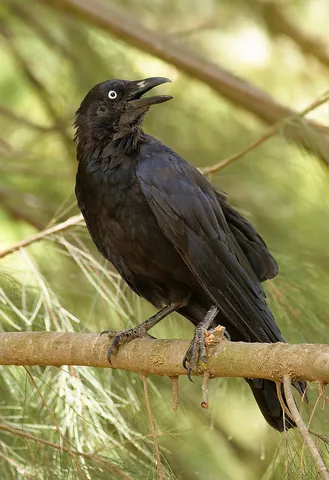
raven noun: any of several, generally large, species of birds in the genus Corvus with lustrous black plumage; especially the common raven (Corvus corax). Also the alternative spelling of ravin.

Noun
raven (countable and uncountable, plural ravens)
- Any of several, generally large, species of birds in the genus Corvus with lustrous black plumage; especially the common raven (Corvus corax).
- Some ſay that Rauens foſter forlorne children, / The vvhilſt their ovvne birds famiſh in their neſts: / Oh be to me though thy hard hart ſay no, / Nothing ſo kinde but ſomething pittifull.c. 1588–1593 (date written), [William Shakespeare], The Most Lamentable Romaine Tragedie of Titus Andronicus: […] (First Quarto), London: […] Iohn Danter, and are to be sold by Edward White & Thomas...
- Thus like the ſad preſaging Rauen that tolls / The ſick mans paſſeport in her hollovv beake, / And in the ſhadovv of the ſilent night / Doth ſhake contagion from her ſable vvings; / Vex'd and tormented runnes poore Barabas / VVith fatall curſes tovvards theſe Chriſtians.c. 1589–1590 (date written), Christopher Marlo[we], edited by Tho[mas] Heywood, The Famous Tragedy of the Rich Iew of Malta. […], London: […] I[ohn] B[eale] for Nicholas Vavasour, […], published...
- A jet-black, often glossy, colour, like that of the plumage of a raven (etymology 1, noun sense 1).
- Near-synonyms: ebony, onyx
- A lone man walks the shores of Nantucket; his noble form is slightly bent, and with the raven of his hair is blended the faintest tinge of gray, though he is evidently a man to whom the meridian of life is yet far in the distance; […]1859, Ferna Vale, “Alone”, in Natalie; or, A Gem among the Sea-weeds, Andover, Mass.: […] W[arren] F. Draper, →OCLC, page 314
- Usually preceded by a descriptive word: a bird from a genus other than Corvus that resembles the raven (etymology 1, noun sense 1), especially in having black plumage; also, an imaginary black bird.
- The horned Indian Raven or Topau, called the Rhinoceros Bird [section heading]. This horned Bird as it caſts a ſtrong ſmell, ſo it hath a foul look, much exceeding the European Raven in bigneſs.1678, Francis Willughby, “Birds of the Crow-kind”, in John Ray, transl., The Ornithology of Francis Willughby […] Wherein All the Birds hitherto Known, Being Reduced into a Method Sutable to Their...
- VVhen the great ſea-raven, as Jacobſon informs us, comes to take avvay their young, the puffins boldly oppoſe him. […] As ſoon as the raven approaches, the puffin catches him under the throat vvith its beak, and ſticks its clavvs into his breaſt, vvhich makes the raven, vvith a loud ſcreaming...1791, Oliver Goldsmith, “Of the Auk, Puffin, and Other Birds of the Penguin Kind”, in An History of the Earth, and Animated Nature. […], new edition, volume VI, London: […] F[rancis] Wingrave...
- A flag bearing a raven (etymology 1, noun sense 1), formerly used by some Viking leaders
- preceded by the: Viking military power.
- Behold the vvarrior bright vvith Daniſh ſpoils!— / The raven droops his vvings—and hark! the trumpet, / Exulting, ſpeaks the reſt.1740 August 12 (first performance; Gregorian calendar), [James Thomson, David Mallet], Alfred: A Masque. […], London: […] A[ndrew] Millar, […], published 1740, →OCLC, Act II, scene iii, page 36
- A person, especially a man, with black hair.
- A person who brings bad news or makes pessimistic predictions.
- Ric[hard]. Novv y'ave ſpoke it halfe; 'tis ſinking I muſt treate of; / Your ſhips are all ſunke. / […] / M[istress] Foſt[er]. O thou fatall Raven; Let me pull thine eyes out for this / Sad croake.c. 1610–1614 (date written), William Rowley; [possibly also Thomas Heywood, George Wilkins], A New Wonder, a Woman never Vext. A Pleasant Conceited Comedy: […], London: […] G[eorge] P[urslowe] for...
- Mal[icorn]. O my dear Lord, upon this onely day / Depends the ſeries of your follovving Fate: / Think your good Genius has aſſum'd my ſhape / In this Prophetick doom. / Guiſe. Peace croaking Raven, / I'le ſeize him firſt, then make him a led Monarch; […]1682 December 15 (first performance; Gregorian calendar), [John] Dryden, [Nathaniel] Lee, The Duke of Guise. A Tragedy. […], London: […] T[homas] H[odgkin] for R[ichard] Bentley […], and J[acob]...
Adjective
raven (not comparable)
Verb
UK/ˈɹæv(ɪ)n/US/ˈɹæv(ə)n/
raven (third-person singular simple present ravens, present participle ravening, simple past and past participle ravened)
- Sometimes followed by away or from: to obtain or seize (something, especially property) by force or violence; to plunder.
- [They] aſſaulted by night a certen aũciẽt [auncient] gentleman at home in his owne houſe, which had done thē [them] no diſpleaſure, and being a ſlepe in his bed at their cõming [comming], whan he had hardly eſcaped awaye half naked, rauening and diſtroying his goodes, they ſpoyled his wyfe and...1560 October 5 (Gregorian calendar), John Sledaine [i.e., Johannes Sleidanus], “The .XXIJ. Booke”, in Ihon [i.e., John] Daus, transl., A Famouse Cronicle of Oure Time, Called Sleidanes Commentaries...
- Sometimes followed by down, up, or (obsolete) in: to eat (something, such as food or prey) greedily; to devour, to wolf down.
- Her princes in the middes thereof are like vvolues, rauening yͤ pray [prey] to ſhed blood, and to ſhed blood, and to deſtroye ſoules for their ovvne couetous lucre.1560, [William Whittingham et al., transl.], The Bible and Holy Scriptures Conteyned in the Olde and Newe Testament. […] (the Geneva Bible), Geneva: […] Rouland Hall, →OCLC, Ezekiél XXII:27, folio...
- [C]ertaine young men vvhom they call Giamoglans, vvith others that ſtood round about them, ſnatcht it [the food] haſtily vp as their fees, and like greedie Harpies rauened it dovvne in a moment.1603, Richard Knolles, “The Life of Selymus, the Second of that Name, Fift Emperour of the Turkes”, in The Generall Historie of the Turkes, […], London: […] Adam Islip, →OCLC, page 833
- To absorb or take in (something, such as information) greedily; also, to approach or pounce on (someone) like prey.
- [S]he fenced them in their need / With iron-handed Duty's sternest creed, / 'Gainst Self's lean wolf that ravens word and deed.1875 April 19 (date delivered; published 1875 June), James Russell Lowell, “Ode Read at the One Hundredth Anniversary of the Fight at Concord Bridge, 19th April, 1875”, in Three Memorial Poems...
- But some characters in books are very real—Jane Austen's are; and I know those five Bennets at the opening of Pride and Prejudice, simply waiting to raven the young men at Netherfield Park, are not giving one thought to the real facts of marriage.1948 October, Dodie Smith, chapter V, in I Capture the Castle, Boston, Mass.: Little, Brown and Company, →OCLC, part I (The Sixpenny Book: March), pages 55–56
- Followed by about, after, or for: to go after or seek for something, especially booty or spoils; to maraud, to plunder; also (generally), to move about wildly and cause damage; to rampage.
- [T]he ſouldiours not yet ſatisfied with ſpoiling and ſacking the reſt that they found in the ſaid Tailleret, raging about the confines thereof, rauened and made hauocke on euery ſide, of whatſoeuer they could lay hands on, taking priſoners both men and women, which were loden with carriage.1610 October, John Foxe, The Second Volume of the Ecclesiasticall Historie, Containing the Acts and Monuments of Martyrs, […], 6th edition, volume II, London: […] [Humphrey Lownes] for the Company of...
- [T]he Inhabitants of the Countrey, a barbarous and inhumane people (as generally Sea-borderers are) and inur'd to the ſpoil of VVracks, vvere not over haſty to acquaint the Duke's Officers vvith this, that they might not be diſturbed vvhilst buſie ravening after Booty.1670, [Guillaume] Girard, “The Ninth Book”, in Charles Cotton, transl., The History of the Life of the Duke of Espernon, the Great Favourite of France. […], London: […] E. Cotes, and A. Clark, for...
- To eat greedily; also, followed by on or upon: of an animal: to prey on.
- The couaitous deſyre of riche men is euer vnſaciable. It always raueneth and neuer is ſatisfied.1545 July 12 (Gregorian calendar), Thomas Elyot, A Preseruatiue agaynste Deth, London: […] Thomas Berthelet, […], →OCLC, signature [B.vi.], recto
- For he [Daphnis] had doubled the number [of goats] he had received of Lamo, nor had the Wolf raven'd away so much as one, and they were all more twaddling fat then the very sheep.1657, Longus, “The Fourth Book”, in George Thornley, transl., Daphnis & Chloe […], [S.l]: [s.n.], published 1920s?, →OCLC, page 154
- Sometimes followed by about or on: to move about searching for food or prey ravenously.
- [T]he Arms and Hands of the Bear, […] are his ſtrength and inſtrument of action to raven and prey vvith; […]1680, Henry More, chapter XIII, in Apocalypsis Apocalypseos; or The Revelation of St John the Divine Unveiled. […], London: […] J. M. for J[ohn] Martyn, and W. Kettilby, […], →OCLC, page 124
- Sometimes followed by after or for: to have a ravenous appetite or craving for food or prey.
- [B]ecause hogs are commonly rauening for their meat, more then other cattel, it is meet therefore to haue them ringed, or elſe they will doe much hurt in digging and turning vp corne fieldes, […]1587, Leonard Mascall, “The Nature and Qualities of Hogges, & also the Gouernement thereof”, in The First Booke of Cattell. Wherein is Shewed, the Gouernement of Oxen, Kine, and Calues, and How to...
- They passed along towards the great hall-door, where the winds howled and ravened for their prey; […]1852 December, [Elizabeth Gaskell], “The Old Nurse’s Story”, in Lizzie Leigh; and Other Tales. […], copyright edition, Leipzig, Saxony: Bernhard Tauchnitz, published 1855, →OCLC, page 115
- Originally followed by with: to experience great hunger; to be ravenous.
- For hovv […] ſhall I knovv thee to be a man, vvhen thou kickeſt like an aſſe, neygheſt like an Horſe after vvomen, raueſt in luſt like a Bull, raueneſt like a Beare, ſtingeſt like a Scorpion, rakeſt like a VVolfe, as ſuttle as a Foxe, as impudent as a Dogge; ſhall I ſay thou art man that haſt all...1621, Democritus Junior [pseudonym; Robert Burton], “Democritus Iunior to the Reader”, in The Anatomy of Melancholy, […], Oxford, Oxfordshire: […] John Lichfield and Iames Short, for Henry Cripps...
- To take and exploit or make use of greedily.
- Sometimes followed by after or for: to have a strong craving or desire for, or to do, something; to crave, to desire, to yearn.
- Here's my brother thirsting, ravening to make your acquaintance—and by George! you are in luck's way, young hopeful, to make his.1892, S[abine] Baring-Gould, “Jamie’s Ride”, in In the Roar of the Sea: A Tale of the Cornish Coast […], volume II, London: Methuen & Co. […], →OCLC, page 33
- Take your conscience—what is the choice? On one side the great temple where you can gather the good harvest—on the other a dirty little scandal that you’ve nosed out to fling to paper scavengers who feed it to their readin' millions ravening for pornographic dirt.1931 August, James B[ernard] Fagan, “The Improper Duchess”, in Famous Plays of 1931, London: Victor Gollancz […], published February 1932, →OCLC, Act III, page 237
Proper noun capitalized: Raven
Raven
- A surname.
- William King, Daniel Giles, and Samuel Raven, the other defendants in the bill named, who were described as the trustees nominated by the parties, of the fifth part.1833, “Easter term 1833”, in The Law Journal for the Year 1832-1833, page 155
- Mr. F. Haydon said he was an undertaker at Stockwell. He conducted the funeral of W. Raven, the registry of whose death was proved by Mr. Booth1855 November, “A narrative of law and crime”, in Charles Dickens, editor, The Household Narrative of Current Events, page 246
- A female given name from English, usually for a girl with raven hair, used since the 1970s.
- I want you to do a background check on a woman named Raven Anderson. Waist-length black hair, violet eyes, tall, striking. Late twenties, I'd say.1987, Kay Hooper, Raven on the Wing, page 33
- Her name was Raven, and she had the reddest hair and the most beautiful green eyes.2015 November 3, Cristina Grenier, “Giving Thanks”, in The Perfect Gift, Monster Media, →ISBN
- A male given name.
- Raven Allen — Originally from the Zone, he becomes a member of the Psi:Ko when he is kidnapped with his brothers by trackers.2013, Natsuya Uesugi, grydscaen, page 9
- A community in Red Deer County, Alberta, Canada, possibly named after the Raven River.
- An unincorporated community in Prairie Township, Edgar County, Illinois.
- An unincorporated community in Knott County, Kentucky.
- An unincorporated community in Brown County, Nebraska.
- A census-designated place in Russell County and Tazewell County, Virginia.
- A village in Kardzhali province, Bulgaria.
- A village in Gostivar municipality, North Macedonia.
- Synonym of Corvus (“a constellation of the southern sky south of the constellation Virgo, said to resemble a crow”).
- Synonyms:
- Corvus
Also used as
raven is also the alternative spelling of ravin.
raven meaning in Hindi, Tamil, Marathi and Bengali
raven in Hindi
- any of several, generally large, species of birds in the genus Corvus with lustrous black plumage
- काला कौआ kālā kauā
raven in Tamil
- ராவேன்
raven in Marathi
- any of several, generally large, species of birds in the genus Corvus with lustrous black plumage
- डोमेकाव्ळा ḍomekāvḷā
raven in Bengali
- any of several, generally large, species of birds in the genus Corvus with lustrous black plumage
- দাঁড়কাক dãṛokak
More languagesFewer languages
- raven in Telugu
- రావెన్, రావేన్
- raven in Malayalam
- റാവൻ, റാവെൻ
- raven in Kannada
- ಕಾರ್ಗೊರಲಕಾಗೆ kārgoralakāge
- raven in Odia
- ରେଭେନ୍, ରାଭେନ୍, ରାୱେନ୍
- raven in Assamese
- ঢোঁৰাকাউৰী dhü̃rakauri
- raven in Nepali
- रावेन, रेभेन, रेवेन
- raven in Arabic
- غُرَاب ḡurāb, غراب ḡurāb
- raven in Indonesian
- gagak besar
- raven in Persian
- زاغ zâġ, کلاغ kalâġ, غراب ġorâb
- raven in Thai
- นกเรเวน
- raven in Vietnamese
- quạ
Examples of raven in a sentence
- She was a tall, sophisticated, raven-haired beauty.
- [T]he Danes bare in their Enſigne a Raven vvrought (by report) in needle-vvorke, by the daughters of Lothbroke that is, Leather-breech, […]1610, William Camden, “Denshire”, in Philémon Holland, transl., Britain, or A Chorographicall Description of the Most Flourishing...
- As from an ancestral oak / Two empty ravens sound their clarion, / Yell by yell, and croak by croak, / When they scent the noonday smoke / Of fresh human carrion: […]1819 (date written), Percy Bysshe Shelley, “Similes”, in [Mary] Shelley, editor, The Poetical Works of Percy Bysshe Shelley. […], volume...
- If the men of Thule have ceased to be champions, and to spread the banquet for the raven, the women have not forgotten the arts that lifted them of yore into queens and prophetesses.1822, [Walter Scott], chapter V, in The Pirate. […], volume I, Edinburgh: […] [James Ballantyne and Co.] for Archibald Constable and Co....
- Along the wild mountains night-ravens were yelling— / They bodingly presaged destruction and woe.1808 (date written), Percy Bysshe Shelley, “Victoria”, in William Michael Rossetti, editor, The Poetical Works of Percy Bysshe Shelley...
Synonyms of raven
Forms of raven
| Noun | |
|---|---|
| plural | ravens |
| Adjective | |
| comparative | more raven |
| superlative | most raven |
| Verb | |
| third-person singular present | ravens |
| present participle | ravening |
| past participle | ravened |
| past | ravened |
| second-person singular present (archaic) | ravenest |
| second-person singular past (archaic) | ravenedst |
| third-person singular present (archaic) | raveneth |
Origin of raven
From Middle English raven, reven (“raven (Corvus corax); carrion crow (Corvus corone); rook (Corvus frugilegus) (?); the constellation Corvus; gall nuts of the Aleppo oak (Quercus infectoria) used to make black ink”), from Old English hræfn (“raven”), from Proto-West Germanic *hrabn (“raven”), from Proto-Germanic *hrabnaz (“raven”), probably from Proto-Indo-European *ḱrep- (“to crackle; to rattle”) or *ḱer- (“to croak, crow”), probably ultimately onomatopoeic, referring to the bird’s call.
A variant of ravin, from Middle English ravin, ravine, raven (noun).
Words formed from raven
- raven-black
- raven-haired
- as the raven flies
- Indian raven
- night-raven
- nonraven
- Ravenclaw
- Raven Crown
- ravendom
- ravenduck
- raven's duck
- ravenette
- raven fish
- raven-foot, raven's foot
- ravenhood
- ravenish
- ravenless
- ravenlike
- ravenly
- ravenmaster
- raven-messenger
- Raven Mocker
- ravenness
- raven paradox
- raven parrot
- ravenry
- raven's bill
- raven's bone
- raven's book
- raven's eye
- ravenstone
- sea raven
- water raven
Phrases with raven
Words that rhyme with raven
Questions about raven
- What does raven mean?
- Raven means any of several, generally large, species of birds in the genus Corvus with lustrous black plumage; especially the common raven (Corvus corax).
- What is raven in Hindi?
- Raven in Hindi is काला कौआ (kālā kauā). See Raven meaning in Hindi.
- How do you use raven in a sentence?
- She was a tall, sophisticated, raven-haired beauty.
- What part of speech is raven?
- Raven can be a noun, an adjective, a verb or a proper noun.
- How do you pronounce raven?
- Raven is pronounced /ˈɹeɪvn̩/ (UK).
- What is the plural of raven?
- The plural of raven is ravens.
Words near raven in the dictionary
Source and license
Adapted from Wiktionary: raven (page history and authors); Raven (page history and authors); raven (Tamil, IndicTrans2 machine translation) (model and license); raven (Telugu, IndicTrans2 machine translation) (model and license); raven (Malayalam, IndicTrans2 machine translation) (model and license); raven (Odia, IndicTrans2 machine translation) (model and license); raven (Nepali, IndicTrans2 machine translation) (model and license). Text available under the Creative Commons Attribution-ShareAlike 4.0 license. Word.ws reformatted the entry and added links. Wiktionary data of 2026-09-02.
Last updated:
Pronunciation audio from Wikimedia Commons, each file under its own free license: LL-Q1860 (eng)-Naomi Persephone Amethyst (NaomiAmethyst)-raven.wav, LL-Q1860 (eng)-Vealhurl-raven (not bird).wav.
Cite this entry: “raven.” Word.ws, https://word.ws/raven. Based on Wiktionary, CC BY-SA 4.0.