
pug
/pʌɡ/
More pronunciations (1)Fewer pronunciations
Australia/pɐɡ/
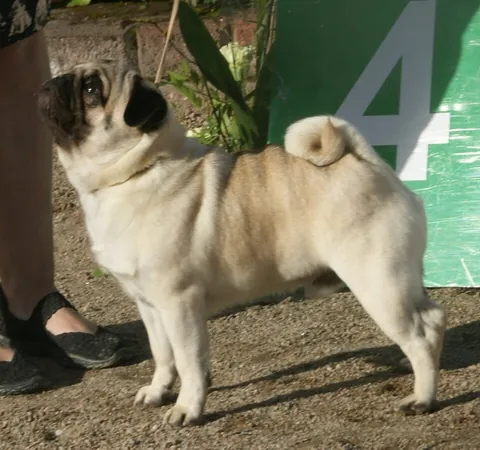
pug noun: a pug dog, a small dog of an ancient breed originating in China, having a snub nose, wrinkled face, squarish body, short smooth hair, and curled tail. Also the alternative letter-case form of PuG.

Noun (1)
pug (plural pugs)
- A pug dog, a small dog of an ancient breed originating in China, having a snub nose, wrinkled face, squarish body, short smooth hair, and curled tail.
- She […] tells Fibs, makes Miſchief, buys China, cheats at Cards, keeps a Pug-dog, and hates the Parſons; […]1740 (first performance), David Garrick, Lethe. A Dramatic Satire. […], Dublin: […] S. Powell, [f]or G. and A. Ewing, G. Faulkner, J. Hoey, J. Exshaw, J. Exdall, and R. James, […], published 1749...
- Meanwhile she arranged her ornaments in the room which she had won too easily. They were strange ornaments to bring on a sea-voyage—china pugs, tea-sets in miniature, […]1915, Virginia Woolf, chapter II, in The Voyage Out, London: Duckworth & Co., […], →OCLC, page 26
- Synonyms:
- carlin, Chinese pug, Dutch bulldog, Dutch mastiff, mini mastiff, mops
- A pug moth, often with a descriptive word: any geometrid moth of the tribe Eupitheciini, especially the genus Eupithecia; a geometer moth.
- In full pug hood: a hood, sometimes with a short cloak attached, worn by women around the middle of the 18th century.
- In full pug engine: a small locomotive chiefly used for shunting (“moving trains from one track to another, or carriages from one train to another”).
- Also used as a proper name: any of various animals, such as a ferret, hare, squirrel, or young salmon.
- Dear, delicate Madam, I am your little Paraquit, your Sparrovv, your Shock, your Pugg, your Squirrel.1685 July (first performance), N[ahum] Tate, Cuckolds-Haven: Or, An Alderman No Conjurer. A Farce. […], London: […] J. H. and are to be sold by Edward Poole, […], published 1685, →OCLC, Act I, scene...
- Squirrels / Are not uncommon in the plantings on the broad edges, where they may be seen feeding on the deal-apples, as the Broadsmen call the fir-cones; nuts and acorns too they are fond of. […] Stoats sometimes chase them, but "pug" generally manages to escape, an[d] he can get to a tree first—he...1895, P[eter] H[enry] Emerson, “Shrew Mouse, or Rana, and Squirrels”, in Birds, Beasts and Fishes of the Norfolk Broadland, London: David Nutt, […], →OCLC, page 363
- Synonym of teg (“a sheep (originally a ewe) in its second year, or from the time it is weaned until it is first shorn”).
- It is to be observed in this experiment, […] that the loss of weight by feeding (tegs or pugs) on turnips, is remarkable: […]1808, Thomas Batchelor, “Live Stock”, in General View of the Agriculture of the County of Bedford. […], London: […] [B. MᶜMillan] for Richard Phillips, […], →OCLC, section 2 (Sheep), page 541
- Synonyms:
- teg
- An ape, a monkey; also (by extension) a human child.
- […] I heard her call him dear pug, and found him to be her favourite monkey.1712 October 12 (Gregorian calendar), [Joseph Addison], “WEDNESDAY, October 2, 1712”, in The Spectator, number 499; republished in Alexander Chalmers, editor, The Spectator; a New Edition, […]...
- Its proper Povver to hurt, each Creature feels, / Bulls aim their Horns, and Aſſes lift their Heels, / 'Tis a Bear's Talent not to kick, but hug, / And no Man vvonders he's not ſtung by Pug: […]1733, Alexander Pope, The First Satire of the Second Book of Horace, […], London [actually Edinburgh]: […] L[awton] G[illiver] and sold by A. Dodd […], E[lizabeth] Nutt […], →OCLC, page 13
- A fox.
- [T]here is a dead silence, till pug is well out of cover, and the whole pack well in: then cheer the hounds with tally ho! till your lungs crack. Away he goes in gallant style, and the whole field is hard up, till pug takes a stiff country: […]1812, [Maria] Edgeworth, “The Absentee. Chapter VIII.”, in Tales of Fashionable Life (2nd series), volume VI, London: […] [Heney] for J[oseph] Johnson and Co., […], →OCLC, pages 93–94
- That spell was broken by the sight of poor wearied pug, his once gracefully-floating brush all draggled and drooping, as he toiled up the sheep-paths toward the open down above.1848, [Charles Kingsley], “The Philosophy of Fox-hunting”, in Yeast: A Problem. […], London: John W[illiam] Parker, […], published 1851, →OCLC, page 16
- A person or thing that is squat (“broad and short”).
- A bun or knot of hair; also, a piece of cloth or snood for holding this in place.
- A small demon; an imp, a puck, a sprite.
- Satan. The great diuell. / Pvg. The leſſe diuell.1616 October or November (first performance), Ben Jonson, “The Persons of the Play”, in The Diuell is an Asse: A Comedie […], London: […] I. B. for Robert Allot, […], published 1631, →OCLC, page 93
- In Iohn Mileſius any man may reade / Of Diuels in Sarmatia honored, / Call'd Kottri, or Kibaldi; ſuch as vvee / Pugs and Hob-goblins call.1635, Tho[mas] Heywood, “The Ninth Tractat: The Angell”, in The Hierarchie of the Blessed Angells. […], London: […] Adam Islip, →OCLC, page 574
- Chiefly used by servants: A senior or upper servant in a household.
- Procedure would vary a little from household to household. Thus, the roast might be ceremonially borne out ahead of the departing ‘Pugs,’ or it might be left behind so that the lower servants could have second helpings.1962, E[rnest] S[ackville] Turner, “The Female Branch”, in What the Butler Saw: Two Hundred and Fifty Years of the Servant Problem, London: Michael Joseph, →OCLC, page 119
Show 4 more meaningsShow fewer meanings
- A mistress, or a female prostitute; also (generally, derogatory) a woman.
- [R]emember the Lo[rd] Admyrall [Charles Howard, 1st Earl of Nottingham] and the Lord Threasurer [Thomas Sackville, 1st Earl of Dorset] with a couple of Pugges or some vscough baugh [i.e., usquebaugh or whiskey] or some such toyes, it would shew that you do not neglect them, whoe, I protest, are to...1600 October 4 (date written; Gregorian calendar), Robert Cecil, “[Letter] X”, in John MacLean, editor, Letters from Sir Robert Cecil to Sir George Carew (Camden Series; 88), [London]: […] [John...
- So euery lip has his Lettice to himſelfe: […] the VVeſterne-man his Pug, the Seruing-man his Punke, […]1604 (first performance), Tho[mas] Dekker; Iohn Webster [i.e., John Webster], West-ward Hoe. […], London: […] [William Jaggard], and to be sold by Iohn Hodgets […], published 1607, →OCLC, Act II...
- A term of endearment for a person, or sometimes an animal or a toy such as a doll.
- I haue had foure huſbands my ſelfe. The firſt I called, Svveete Duck, the ſecond, Deare Heart; the third, Prettie Pugge: But the fourth, moſt ſvveete, deare, prettie, all in all: he vvas the verie cockeall of a huſband.1600 or 1601 (date written), I. M. [i.e., John Marston], Antonios Reuenge. The Second Part. […], London: […] [Richard Bradock] for Thomas Fisher, and are to be soulde [by Matthew Lownes] […]...
- She ſings. / VVell met, pug, the pearle of beauty: vmh, vmh. / Hovv novv ſir knave, you forget your dutie, vmh, vmh.1604 (date written), Tho[mas] Dekker, [Thomas Middleton], The Honest Whore. […] (4th quarto), London: […] Nicholas Okes for Robert Basse, […], published 1616, →OCLC, Act I, signature [C4], recto
- A bargeman.
- Dares […] [W]ilt thou neuer trauell? / Epi[ton]. Yes in a VVeſterne barge, vvhen vvith a good vvinde and luſtie pugges, one may goe ten miles in tvvo daies.c. 1588 (date written; published 1591), [John Lyly], Endimion, the Man in the Moone. […], London: […] I[ohn] Charlewood, for the widdowe Broome, →OCLC, Act IV, scene ii, signature G, verso
- [E]uen the Weſterne Pugs receiuing mony here, haue tyed it in a bag at the end of their barge, and ſo trailed it through the Thames, leaſt pleague ſores ſticking vpon ſhillings, […]1603, [Thomas Dekker], 1603. The Wonderfull Yeare. […], London: […] by [J. Browne, Nicholas Ling, and John Smethwick for?] Thomas Creede, […], →OCLC, signature F3, verso
- Synonyms:
- bargee
- A cabin boy, a shipboy or ship's boy.
- [Ulysses] ty'd his deafen'd Sailors (vvhile he paſs'd / The dreadful Lady's Lodgings) to the Maſt, / And rather venture drovvning, than to vvrong / The Sea-pugs chaſte Ears vvith a bavvdy Song: […]a. 1681 (date written), Samuel Butler, “Satyr”, in R[obert] Thyer, editor, The Genuine Remains in Verse and Prose of Mr. Samuel Butler, […], volume I, London: […] J[acob] and R[ichard] Tonson, […]...
Noun (2)
pug (plural pugs)
- The footprint or pawprint of an animal; a pugmark.
- [T]here were the broad, deep puggs of a tiger, up and down the nullah, in the dry sand, near the water's edge, of all ages, from the week, perhaps, up to the unmistakeable fresh puggs of last night.1851 July, Captain Hardbargain [pseudonym], “A Jungle Recollection”, in Fraser’s Magazine for Town and Country, volume XLIV, number CCLIX, London: John W[illiam] Parker, […], →OCLC, page 19, column 2
- The goat has a square pug with blunt points to his toes, which are always held apart. The sheep's pug is more like that of the boar, being longer than the goat's. […] The boar's pug is distinguished from that of the sow by being much wider in the heel, and having the toes more open, and the...1889, R[obert] S[tephenson] S[myth] Baden-Powell, “Rearing Pig”, in Pigsticking or Hoghunting. […], London: Harrison & Sons, […], →OCLC, § 27, page 55
Verb (1)
pug (third-person singular simple present pugs, present participle pugging, simple past and past participle pugged)
- To track (an animal) by following pawprints; also (by extension) to track (a person) by following footprints.
- Wishing to track a good boar that had got away through some thick cover, we called up the headman of the beat (a man lent to us by a friend) and asked him if he could pug. He was a havildar (sergeant) of police. He replied, 'That is my regular business, sahib; of course I can pug. My work is...1889, R[obert] S[tephenson] S[myth] Baden-Powell, “Rearing Pig”, in Pigsticking or Hoghunting. […], London: Harrison & Sons, […], →OCLC, § 27, page 57
Verb (2)
pug (third-person singular simple present pugs, present participle pugging, simple past and past participle pugged)
- To hit or punch (someone or something); also, to poke (someone or something).
- Agosh! I long to try a bout / With zom o' Burdett's rabble rout; / I'd quickly pug their guts: / I'd gee mun zich a lammin [i.e., violent] lick, / I'd make mun of elections zick; / I'd gee mun all the butts.1812, Peter Pindar [pseudonym; John Wolcot], “The Middlesex Election; or, Poetical Epistles, in the Devonshire Dialect, by Mr. Joseph Budge, in London, to Lord Rolle, at Weymouth”, in The Works of...
- To fill or stop up (a space) with pug (noun etymology 5, noun sense 1), clay, sawdust, or other material by tamping; (specifically) to fill in (the space between joists of a floor, a partition, etc.) with some material to deaden sound, make fireproof, etc.
- Forbid it Venus! From the venal Fair / Snatch every charm, to Hay convert her Locks; / Pug up her nose, and pug-like make her stare; / And pit her pimpled visage with small-pox.1812, Peter Pindar [pseudonym; John Wolcot], “Lord Auckland’s Triumph; or, The Death of Crim. Con. A Pair of Prophetic Odes. Elegy to a Friend.”, in The Works of Peter Pindar, Esq. […], new edition...
- To mix and work (wet clay) until flexible, soft, and free from air pockets and suitable for making bricks, pottery, etc.
- to pug clay ready for shaping
- Of cattle, etc.: to trample (the ground, a place, etc.) until it becomes muddy and soft; to poach.
- To pack or tamp (something) into a small space.
- To pack or tamp into a small space.
Noun (3)
pug (countable and uncountable, plural pugs)
- Clay, soil, or other material which has been mixed and worked until flexible, soft, and free from air pockets and thus suitable for making bricks, pottery, etc.; also, any other material with a similar consistency or function, especially (Australia) auriferous (“gold-bearing”) clay.
- A brickfield certainly is not the place for girls and young women to work in; […] the work they have too, at least those who are pug-bearers, often causes indecency; they have to stoop down to the ground to pick the pug up from the bottom of the mill; at all events, they ought to have their clothes...1866, Mr. Dean, witness, “Children’s Employment Commission (1862). Fifth Report of the Commissioners, […]. [Appendix to Fifth Report. Reports and Evidence of Assistant Commissioners. Evidence on...
- The walls of the house were built of "pug," which means simply well-pounded mud, and has the disadvantage of refusing to adhere firmly to the frames of doors and casements, so that the banging of either, in windy weather, is apt to bring large pieces of the material crumbling down, and the house...1872, Mrs. Edward Millett, chapter III, in An Australian Parsonage; or, The Settler and the Savage in Western Australia, London: Edward Stanford, […], →OCLC, page 55
Verb (3)
pug (third-person singular simple present pugs, present participle pugging, simple past and past participle pugged)
- To pull or tug (something).
- George pugg'd clover in the forenoon.1717 April 10 (date written; Gregorian calendar), Edward Turner, quoting [the anonymous diarist], “The Marchant Diary”, in Sussex Archaeological Collections, […], volume XIII (2nd Series; volume XXV...
- Nae thing was prosperin’ there and thrivin’, / But tirlin’ roofs and rafter-rivin’, / And pullin’ down and puggin’; […][1827, M. W. T. [i.e., William Tennant], “Sang Saxt [Song Sixth]”, in Papistry Storm’d; or, The Dingin’ Down o’ the Cathedral. […] (in Scots), Edinburgh: […] Oliver and Boyd, […], →OCLC, page 211
- To spoil (something) by touching too much.
- ["B]e sure not to wet it up too much; make it into twelve doughboys" (dumplings). / "I'm so heavy-handed," Jane remarked at this point, "I always spoil that sort of cookery." / "Tell about heavy-handed!" cried Betsy; "I'll answer for it, I'll soon put you in the way of being light-handed! You only...1885, E. Cruwys Sharland, chapter IV, in Ways and Means in a Devonshire Village. A Book for Mothers’ Meetings. […], London: Society for Promoting Christian Knowledge, →OCLC, page 55
- Followed by at: to pull or tug.
Noun (4)
pug (countable and uncountable, plural pugs)
- The residue left after pressing apples for cider; pomace.
- Often in the plural: the husks and other refuse removed from grain by winnowing; chaff.
- Radiſh ſeed vvould vvillingly be ſovvne in a looſe or light ground, and natherleſſe moiſt enough: it cannot abide danke mucke, but contenteth it ſelfe vvith rotten chaffe or pugs, and ſuch like plaine mullock.1601, C[aius] Plinius Secundus [i.e., Pliny the Elder], “[Book XIX.] Garden Plants, Their Natures, Kinds, and Severall Histories.”, in Philemon Holland, transl., The Historie of the World. Commonly...
- The pugg, i.e. the refuſe corne left at winnowinge.[a. 1640 (date written), John Smyth, “[Phrases and Proverbs of Speach Proper to This Hundred]”, in John MacLean, editor, The Berkeley Manuscripts: A Description of the Hundred of Berkeley in the...
Noun (5) capitalized: PuG
PuG (plural PuGs)
Verb (4) capitalized: PuG
PuG (third-person singular simple present PuGs, present participle PuGing, simple past and past participle PuGed)
- To participate in structured content of an online game as part of a pickup group.
Also used as
pug is also the alternative letter-case form of PuG.
pug is also the clipping of pugilist.
pug is also the ellipsis of pug mill.
pug meaning in Hindi, Marathi, Urdu and Bengali
pug in Hindi
- पग
pug in Marathi
- पग्
pug in Urdu
- پاگ, پگ کرنا
pug in Bengali
- পাগ
More languagesFewer languages
- pug in Telugu
- పగ్, పుగ్, పగ్ చెయ్యడానికి
- pug in Malayalam
- പഗ്, പഗ് ചെയ്യാൻ
- pug in Kannada
- ಪಗ್
- pug in Gujarati
- પગ્, પગ્ કરવા માટે
- pug in Odia
- ପଗ୍, ପଗ୍ କରିବା ପାଇଁ, ପଗ୍ କରିବାକୁ
- pug in Nepali
- पग, पग्
- pug in Arabic
- بَاك bāk
- pug in Persian
- پاگ pâg
- pug in Thai
- ปั๊ก bpák
- pug in Vietnamese
- pug, chó mặt xệ
Examples of pug in a sentence
- Take avvay the pug, ſaid I, to the attendants—Take it avvay vvhile any of it is left—They reſcued the ſtill ſmiling babe, and run avvay vvith it.1753 (indicated as 1754), [Samuel Richardson], “Letter XLIII. Lady G. to Lady Grandison.”, in The History of Sir Charles Grandison. […]...
- Or, is the Monkey sick, he takes his bed; / Old Slop is sent for, to prescribe for Pug.— […]1812, Peter Pindar [pseudonym; John Wolcot], “Tristia; or, The Sorrows of Peter: […]. Elegy.”, in The Works of Peter Pindar, Esq. […], new...
- This is your Buſineſs Good Pug Robin, / And your Diverſion, dull Dry Bobbing: / T' intice Fanaticks in the Dirt, / And vvaſh 'em clean in Ditches for't.1677 (indicated as 1678), [Samuel Butler], “Canto I”, in Hudibras. The Third and Last Part. […], London: […] Simon Miller, […], →OCLC, page...
- In the vigor of his age he married Gargamelle, daughter to the King of the Parpaillons, a jolly pug, and well mouthed wench.1653, Francis Rabelais [i.e., François Rabelais], translated by [Thomas Urquhart, Peter Anthony Motteux], “How Gargantua was Carried Eleven...
Synonyms of pug
30 more synonymsFewer synonyms
Forms of pug
| Noun | |
|---|---|
| plural | pugs |
| plural | PuGs |
| alternative form | pug |
| Verb | |
| third-person singular present | pugs |
| present participle | pugging |
| past participle | pugged |
| past | pugged |
Origin of pug
Origin unknown, possibly related to West Flemish pugge (“(adjective) small; (noun) short person; pet name derived from the first name Pugge”); though it is uncertain whether sense 1 (“senses relating to someone or something small”) and sense 2 (“senses relating to people”) are derived from the same source. Etymology 1 sense 1.8 (“small demon”) was probably influenced by, though not a variant of, puck.
Acronym of pickup group.
The noun is borrowed from Hindi पग (pag, “step; (less common) foot; leg”), from Old Hindi पगु (pagu), from Sanskrit पद्ग (padga), from पद् (pad, “step; foot”) (ultimately from Proto-Indo-European *ped- (“to step; to walk; to fall; to stumble”)) + ग (ga, stem at the ends of compounds denoting going or moving) (ultimately from Proto-Indo-European *gʷem- (“to step”)). The verb is derived from the noun.
Words formed from pug
- pugmark
- Braun's pughead pipefish
- Chinese pug
- chug
- dentated pug
- false pug moth
- jug
- lawyer pug
- pudge
- pugeranian
- pug-faced roughy
- puggish
- puggishness
- puggy
- pug-headed mudskipper
- puglet
- puglike
- pug-nosed
- pug nose
- pugnose
- pug-nose
- pugship
- pug-ugly
- pugged
- puggle
- pugging
- pug and pine
- pugger
- pugmill
- pug mill
- pug soil
Phrases with pug
Words that rhyme with pug
23 more rhymesFewer rhymes
Questions about pug
- What does pug mean?
- Pug means a pug dog, a small dog of an ancient breed originating in China, having a snub nose, wrinkled face, squarish body, short smooth hair, and curled tail.
- What is pug in Hindi?
- Pug in Hindi is पग. See Pug meaning in Hindi.
- How do you use pug in a sentence?
- Take avvay the pug, ſaid I, to the attendants—Take it avvay vvhile any of it is left—They reſcued the ſtill ſmiling babe, and run avvay vvith it.
- What part of speech is pug?
- Pug can be a noun or a verb.
- How do you pronounce pug?
- Pug is pronounced /pʌɡ/ (UK).
- What is the plural of pug?
- The plural of pug is pugs.
Words near pug in the dictionary
Source and license
Adapted from Wiktionary: pug (page history and authors); PuG (page history and authors); pug (Hindi, IndicTrans2 machine translation) (model and license); pug (Marathi, IndicTrans2 machine translation) (model and license); pug (Urdu, IndicTrans2 machine translation) (model and license); pug (Bengali, IndicTrans2 machine translation) (model and license); pug (Telugu, IndicTrans2 machine translation) (model and license); pug (Malayalam, IndicTrans2 machine translation) (model and license); pug (Kannada, IndicTrans2 machine translation) (model and license); pug (Gujarati, IndicTrans2 machine translation) (model and license); pug (Odia, IndicTrans2 machine translation) (model and license); pug (Nepali, IndicTrans2 machine translation) (model and license). Text available under the Creative Commons Attribution-ShareAlike 4.0 license. Word.ws reformatted the entry and added links. Wiktionary data of 2026-09-02.
Last updated:
Pronunciation audio from Wikimedia Commons, each file under its own free license: LL-Q1860 (eng)-Vealhurl-pug.wav.
Cite this entry: “pug.” Word.ws, https://word.ws/pug. Based on Wiktionary, CC BY-SA 4.0.