
rake
UK/ɹeɪk/
rake noun: a garden tool with a row of pointed teeth fixed to a long handle, used for collecting debris, grass, etc., for flattening the ground, or for loosening soil; also, a similar wheel-mounted tool drawn by a horse or a tractor. Also the alternative spelling of raik.

Noun (1)
rake (plural rakes)
- A garden tool with a row of pointed teeth fixed to a long handle, used for collecting debris, grass, etc., for flattening the ground, or for loosening soil; also, a similar wheel-mounted tool drawn by a horse or a tractor.
- Orion hit a rabbit once; but though sore wounded it got to the bury, and, struggling in, the arrow caught the side of the hole and was drawn out. […] Ikey the blacksmith had forged us a spearhead after a sketch from a picture of a Greek warrior; and a rake-handle served as a shaft.1879, R[ichard] J[efferies], “The Old Punt: A Curious ‘Turnpike’”, in The Amateur Poacher, London: Smith, Elder, & Co., […], →OCLC, pages 19–20
- Synonyms:
- horserake
- A tool with a straight edge at the end used by a croupier to move chips or money across a gaming table.
- A type of lockpick that has a ridged or notched blade that moves across the pins in a pin tumbler lock, causing them to settle into a shear line.
- A type of puffer train that leaves behind a stream of spaceships as it moves.
- I've been dealing primarily with rake and spaceship interactions for ease of experimentation (a rake will invariably escape before being eaten by even its most hellish progeny, and a spaceship is easy to redraw on the spot).1991 January 10, Paul Callahan, “Questions and comments about Conway's Life (long)”, in comp.theory.cell-automata (Usenet)
- That would mean building rake guns or glider gun arrays to construct moving walls.2003 August 19, Ilmari Karonen, “Inquiries about Conway's game of life”, in comp.theory.cell-automata (Usenet)
- A group of mules.
- Plus, his ever-increasing rake of mules were outgrowing the small parcel of acreage he had inherited in Tennessee.2020, Barbara L. Wyckoff, Who Was Victoria Silkee
- making the total payload of a typical rake of mules about 20 times greater than that of even the strongest flameme.2003, Mexico and the United States: Politics, local - Zoot suit riots, Marshall Cavendish, page 830
Verb (1)
rake (third-person singular simple present rakes, present participle raking, simple past and past participle raked)
- To act upon with a rake, or as if with a rake.
- She is raking the gravel path to keep it even.
- We raked all the leaves into a pile.
- Often followed by in: to gather (things which are apart) together, especially quickly.
- The casino is just raking in the cash; it’s like a licence to print money.
- Often followed by an adverb or preposition such as away, off, out, etc.: to drag or pull in a certain direction.
- To claw at; to scrape, to scratch; followed by away: to erase, to obliterate.
- The cat’s sharp claws raked the side of my face.
- Pas could not stay, but over him did rake, / And crown'd the earth with his first touching crowne: [...]c. 1580 (date written), Philip Sidney, “(please specify the folio)”, in [Mary Sidney], editor, The Countesse of Pembrokes Arcadia […] [The New Arcadia], London: […] [John Windet] for William...
- Followed by up: to bring up or uncover (something), as embarrassing information, past misdeeds, etc.
- To search through (thoroughly).
- [...] I have added to both of them [language and poetry] in the choice of Words, and Harmony of Numbers which were wanting, [...] One is for raking in [Geoffrey] Chaucer (our Engliſh Ennius) for antiquated Words, which are never to be reviv'd, but when Sound or Significancy is wanting in the...1697, Virgil, “Postscript to the Reader”, in John Dryden, transl., The Works of Virgil: Containing His Pastorals, Georgics, and Æneis. […], London: […] Jacob Tonson, […], →OCLC, page 621
- The statesman rakes the town to find a plot, / And dreams of forfeitures by treason got.1724, Jonathan Swift, “On Dreams. An Imitation of Petronius.”, in Thomas Sheridan, John Nichols, editors, The Works of the Rev. Jonathan Swift, […], new edition, volume VII, London: […] J[oseph]...
- To move (a beam of light, a glance with the eyes, etc.) across (something) with a long side-to-side motion; specifically (often military) to use a weapon to fire at (something) with a side-to-side motion; to spray with gunfire.
- The enemy machine guns raked the roadway.
- George took the glass again and raked the vessel. "How she does pitch!" he said.1847 January – 1848 July, William Makepeace Thackeray, Vanity Fair […], London: Bradbury and Evans […], published 1848, →OCLC
- To fire upon an enemy vessel from a position in line with its bow or stern, causing one's fire to travel through the length of the enemy vessel for maximum damage.
- To cover (something) by or as if by raking things over it.
- To pick (a lock) with a rake.
Noun (2)
rake (plural rakes)
Noun (3)
rake (plural rakes)
- A course, a path, especially a narrow and steep path or route up a hillside.
- A fissure or mineral vein of ore traversing the strata vertically, or nearly so.
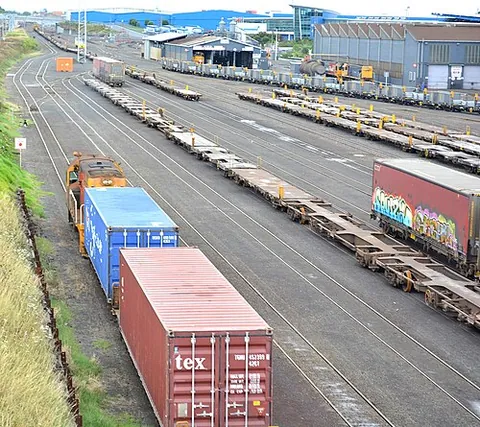
- A series, a succession; specifically (rail transport) a set of coupled rail vehicles, normally coaches or wagons.
- The train was formed of a locomotive and a rake of six coaches.
- On February 21 Class "O4/1" 2-8-0 No. 63635 passed through Manchester (Victoria) heading in the Rochdale direction with a rake of empty wagons.1959 April, “Motive Power Miscellany: London Midland Region”, in Trains Illustrated, London: Ian Allan Publishing, →OCLC, page 222
- Synonyms:
- consist
Verb (2)
rake (third-person singular simple present rakes, present participle raking, simple past and past participle raked)
Noun (4)
rake (plural rakes)
Verb (3)
rake (third-person singular simple present rakes, present participle raking, simple past and past participle raked)
- To incline (something) from a perpendicular direction.
- A mast rakes aft.
- Synonyms:
- slope
- To provide (the bow or stern of a watercraft) with a rake (“a slant that causes it to extend beyond the keel”).
- Of a watercraft: to have a rake at its bow or stern.
Noun (5)
rake (plural rakes)
- A divergence from the horizontal or perpendicular; a slant, a slope.
- In full, angle of rake or rake angle: the angle between the edge or face of a tool (especially a cutting tool) and a plane (usually one perpendicular to the object that the tool is being applied to).
- The direction of slip during the movement of a fault, measured within the fault plane.
- A slant that causes the bow or stern of a watercraft to extend beyond the keel; also, the upper part of the bow or stern that extends beyond the keel.
- A slant of some other part of a watercraft (such as a funnel or mast) away from the perpendicular, usually towards the stern.
- The sloped edge of a roof at or adjacent to the first or last rafter.
Noun (6)
rake (plural rakes)
- A person (usually a man) who is stylish but habituated to hedonistic and immoral conduct.
- We have now and then rakes in the habit of Roman senators, and grave politicians in the dress of rakes. The misfortune of the thing is, that people dress themselves in what they have a mind to be, and not what they are fit for.1711 March 26 (Gregorian calendar), [Joseph Addison; Richard Steele et al.], “THURSDAY, March 16, 1710–1711”, in The Spectator, number 14; republished in Alexander Chalmers, editor, The Spectator; a...
- For honest men delight will take, / To shew you favour for his sake, / Will flatter you; and Fool and Rake / Your steps pursue: / And of your Father's name will make / A snare for you.1807, William Wordsworth, “Address to the Sons of Burns after Visiting Their Father’s Grave, Aug. 14th, 1803”, in Poems, in Two Volumes, volume II, London: […] Longman, Hurst, Rees, and Orme, […]...
- Synonyms:
- roué, adulterer, bed-hopper, carpetmonger, chamberer, debauchee, debaucher, fornicator, gallant, lecher
Verb (4)
rake (third-person singular simple present rakes, present participle raking, simple past and past participle raked)
- To behave as a rake; to lead a hedonistic and immoral life.
- When women hid their necks , and veil'd their faces ,
Nor romp'd , nor raked , nor stared at public places1758, William Shenstone, Epilogue to Cleone
- When women hid their necks , and veil'd their faces ,
Proper noun capitalized: Rake
Rake (countable and uncountable, plural Rakes)
- A surname.
- A village in Rogate parish, Chichester district, West Sussex, England (OS grid ref SU8027).
- A small town in Winnebago County, Iowa, United States, named after a pioneer citizen.
Also used as
rake is also the alternative spelling of raik.
rake meaning in Hindi, Urdu, Bengali and Telugu
rake in Hindi
- garden tool
- जेली jelī
rake in Urdu
- ریک
rake in Bengali
- রেক, রেকে করা
rake in Telugu
- రేక్, రేక్ చెయ్యడానికి
More languagesFewer languages
- rake in Malayalam
- വരണ്ടി varaṇṭi
- rake in Kannada
- ರೇಕ್, ರೇಕ್ ಮಾಡಲು
- rake in Assamese
- জবকা zoboka, জবকিয়া zobokia, লোৰোক lürük
- rake in Nepali
- रेक, रेक गर्न
- rake in Tagalog
- kalaykay
- rake in Arabic
- مِدَمَّة midamma, مُشْط mušṭ, مِشْط mišṭ, مَشْط mašṭ
- rake in Malay
- garu
- rake in Persian
- شنکش šen-keš
- rake in Thai
- คราด krâat
- rake in Vietnamese
- bồ cào, bừa cỏ, bù cào, cào
- rake in Myanmar
- ဂျုတ် gyut, ထွန်ခြစ် htwanhkrac
Examples of rake in a sentence
- The switch engine is unstable but a number of them working in combination can form stable puffers, spaceships and rakes.2015, Paul Rendell, Turing Machine Universality of the Game of Life, page 133:
- Like clouds that rake the mountain-summits, / Or waves that own no curbing hand, / How fast has brother followed brother, / From sunshine to the sunless land!1835 November 30 (date written), William Wordsworth, “Extempore Effusion upon the Death of James Hogg”, in Henry [Hope] Reed, editor, The...
- Jack's gaze raked the room, searching for some indication that something was wrong, that someone was going to suddenly spring forward and grab her.2003 March, Karyn Monk, The Wedding Escape, New York, N.Y.: Bantam Books, →ISBN, page 96:
- "He was a big old rake, full of marks and scars, and he had only an ear and a half."1886, Peter Christen Asbjørnsen, translated by H.L. Brækstad, Folk and Fairy Tales, page 77:
Synonyms of rake
- horserake
- comb
- comb through
- go over with a fine-tooth comb
- scour
- consist
- slope
- roué
- adulterer
- bed-hopper
28 more synonymsFewer synonyms
Forms of rake
| Noun | |
|---|---|
| plural | rakes |
| alternative form | raik |
| Verb | |
| third-person singular present | rakes |
| present participle | raking |
| past participle | raked |
| past | raked |
Origin of rake
From Middle English rake [and other forms], from Old English raca, racu, ræce (“tool with a row of pointed teeth, rake”), from Proto-Germanic *rakō, *rekô (“tool with a row of pointed teeth, rake”), from Proto-Indo-European *h₃reǵ- (“to straighten, right oneself”). Cognates The English word is cognate with Danish rage (chiefly regional), Middle Dutch rāke, rēke (modern Dutch raak, reek (both regional), riek (“pitchfork, rake”)), Middle Low German rāke, racke (modern German Low German Raak (“rake; poker”)), Old High German rehho, rech (Middle High German reche, modern German Rechen (“rake”)), Old Norse reka (“shovel”) (modern Icelandic reka (“shovel”)), Old Saxon recho, Old Swedish raka (modern Swedish raka (“rake; (long) straight section of a road”)).
The verb is partly derived from rake (“tool with a row of pointed teeth”) (see etymology 1) and from Middle English raken (“to rake; to gather by raking; to rake away (debris); to cover with something; (figurative) to conceal, hide; to destroy”) [and other forms], from Old Norse raka (“to scrape”), from Proto-Germanic *raką, probably ultimately from Proto-Indo-European *h₃reǵ- (“to straighten, right oneself”). Cognates The English word is cognate with Middle Dutch rāken (modern Dutch raken (“to rake”) (regional)), Middle Low German rāken, Old Danish raghæ, rakæ (modern Danish rage (“to shave”)), Old Swedish raka (modern Swedish raka (“to rake; to shave”)). The noun is derived from the verb.
From Middle English rake, rakke (“pass, path, track; type of fencing thrust; pasture land (?)”), and then partly: * probably from Old English racu (“bed of a stream; path; account, narrative; explanation; argument, reasoning; reason”) (compare Old English hrace, hraca, hracu (“gorge”)), from Proto-Germanic *rakō (“path, track; course, direction; an unfolding, unwinding; account, narrative; argument, reasoning”) [and other forms], from Proto-Indo-European *h₃reǵ- (“to straighten, right oneself”); and * from Old Norse rák (“strip; stripe; furrow; small mountain ravine”), further etymology uncertain but probably ultimately from Proto-Germanic *rakō, as above. Cognates The English word is cognate with Icelandic rák (“streak, stripe; notch in a rock; vein in stone or wood”), Norwegian råk (“channel (in ice); cow path; trail”), Norwegian Nynorsk råk (“channel (in ice); cow path; trail; furrow; stripe”), Swedish råk (“crack or channel in ice; river valley”); and probably cognate with Old Danish rag (modern Danish rag (“stiff; taut”) (regional)), Old Norse rakr (“straight”), Swedish rak (“straight”).
Words formed from rake
- rakehood
- rakery
- rakish
- raky
- cavex rake
- clam rake
- de-thatching rake
- dethatching rake
- fire rake
- grass rake
- hay rake
- hayrake
- hell-rake
- horserake
- lawn rake
- rakeback
- rakeful
- rakehoe
- rakeless
- rakelike
- rakemaker
- raker
- rake receiver
- rakestale
- rake-stepping
- roof rake
- snake rake
- spring rake
- step on a rake
- stubble rake
- thatcher's rake
- thatching rake
- thatch rake
- thatch-rake
- thin as a rake
- top rake
- muckrake
- overrake
- rakeable
- rake and scrape
- rake-and-scrape
- rake in
- rake it in
- rake 'n' scrape
- rake-'n'-scrape
- rake off
- rake out
- rake over
- rake over old coals
- rake over the coals
- rake together
- rake up
- rerake
- unrake
- unraked
Phrases with rake
Words that rhyme with rake
48 more rhymesFewer rhymes
- slake
- stake
- wake
- sheikh
- strake
- betake
- mosaic
- blake
- fake
- jake
- opaque
- forsake
- lake
- mistake
- raik
- retake
- sake
- claik
- hake
- partake
- quake
- Spirit Lake
- steak
- ache
- remake
- spake
- tea break
- wrake
- ake
- alphamosaic
- ashake
- Choctaw Lake
- crake
- Deer Lake
- demake
- eastern green drake
- glass snake
- laik
- moonquake
- Mud Lake
- nake
- overtake
- parliament cake
- prison break
- radiopaque
- rattlesnake
- reshake
- sodaic
Questions about rake
- What does rake mean?
- Rake means a garden tool with a row of pointed teeth fixed to a long handle, used for collecting debris, grass, etc., for flattening the ground, or for loosening soil; also, a similar wheel-mounted tool drawn by a horse or a tractor.
- What is rake in Hindi?
- Rake in Hindi is जेली (jelī). See Rake meaning in Hindi.
- How do you use rake in a sentence?
- The switch engine is unstable but a number of them working in combination can form stable puffers, spaceships and rakes.
- What part of speech is rake?
- Rake can be a noun, a verb or a proper noun.
- How do you pronounce rake?
- Rake is pronounced /ɹeɪk/ (UK).
- What is the plural of rake?
- The plural of rake is rakes.
Words near rake in the dictionary
Source and license
Adapted from Wiktionary: rake (page history and authors); Rake (page history and authors); rake (Urdu, IndicTrans2 machine translation) (model and license); rake (Bengali, IndicTrans2 machine translation) (model and license); rake (Telugu, IndicTrans2 machine translation) (model and license); rake (Kannada, IndicTrans2 machine translation) (model and license); rake (Nepali, IndicTrans2 machine translation) (model and license). Text available under the Creative Commons Attribution-ShareAlike 4.0 license. Word.ws reformatted the entry and added links. Wiktionary data of 2026-09-02.
Last updated:
Pronunciation audio from Wikimedia Commons, each file under its own free license: En-us-rake.ogg.
Cite this entry: “rake.” Word.ws, https://word.ws/rake. Based on Wiktionary, CC BY-SA 4.0.