
rout
/ɹaʊt/
More pronunciations (1)Fewer pronunciations
Canada[ɹʌʊt]
rout noun: a group of people; a crowd, a throng, a troop; in particular (archaic), a group of people accompanying or travelling with someone.

Noun (1)
rout (countable and uncountable, plural routs)
- A group of people; a crowd, a throng, a troop; in particular (archaic), a group of people accompanying or travelling with someone.
- A route of people there aſſembled were, / Of euery ſort and nation vnder skye, [...]1590, Edmund Spenser, “Book II, Canto VII”, in The Faerie Queene. […], London: […] [John Wolfe] for William Ponsonbie, →OCLC, stanza 44, page 284
- The Incorporations this year did moſtly conſiſt of Cantabrigians who had lately come to this University for preferment from the Viſitors, when the great rout of Royalliſts were by then made in this University.1691, [Anthony Wood], “Fasti Oxonienses”, in Athenæ Oxonienses. An Exact History of All the Writers and Bishops who have had Their Education in the Most Ancient and Famous University of Oxford from...
- A group of animals, especially one which is lively or unruly, or made up of wild animals such as wolves; a flock, a herd, a pack.
- The harts and hinds in their herds, the boars in their singulars, the skulls of foxes, the richesses of martens, the bevies of roes, the cetes of badgers and the routs of wolves - all came to him more or less as something which you either skinned or flayed and then took home to cook.1958, T.H. White, The Once and Future King
- A group or assortment of snails.
- hiruvananthapuram: Routs of snails are invading parts of the city, sending residents into a tizzy, amid fears that they would pose a health hazardAugust 4, 2011, Mohamed Nazeer, “Archived copy”, in The Hindu News, archived from the original on 20 Sep 2018
- We spot several routs of snails moving around, half buried in the sandy beach.2022 December 15, Tania Banerjee, “Offbeat Mumbai: A shorewalk in Juhu”, in Azure Sky Follows
- Synonyms:
- escargatoire
- A group of disorganized things.
- A group of (often violent) criminals or gangsters; such people as a class; (more generally) a disorderly and tumultuous crowd, a mob; hence (archaic, preceded by the), the common people as a group, the rabble.
- Beſides the endleſſe routs of wretched thralles, / VVhich thether were aſſembled day by day, / From all the world after their wofull falles, / Through wicked pride, and waſted welthes decay.1590, Edmund Spenser, “Book I, Canto V”, in The Faerie Queene. […], London: […] [John Wolfe] for William Ponsonbie, →OCLC, stanza 51, page 74
- The Ring-leader and Head of all this Rout, / Haue practis'd dangerouſly againſt your State, / Dealing with Witches and with Coniurers, [...]1591 (date written), William Shakespeare, “The Second Part of Henry the Sixt, […]”, in Mr. William Shakespeares Comedies, Histories, & Tragedies. […] (First Folio), London: […] Isaac Iaggard, and...
- A fashionable assembly; a large evening party, a soirée.
- The Ducheſs or Marlborough had one of the grandeſt routs that has been given for ſome time, almoſt the whole of the firſt people of rank and faſhion in England being preſent. This being a new birth to conviviality in Marlborough Houſe, and the firſt rout for theſe ſeven laſt years, it was...1783 May, “Domestic Occurrences. [Thursday 8.]”, in Sylvanus Urban [pseudonym; Edward Cave], editor, The Gentleman’s Magazine and Historical Chronicle, volume LIII, London: […] John Nichols, for D....
- Come then, ſweet ſpring's delights to taſte; / No longer, my Maria, waſte / Thoſe hours in routs and noiſe, [...]1799 January, “An Ode. The Invitation.”, in The Monthly Magazine, or British Register, volume VII, part I, number XLI, London: […] R[ichard] Phillips, […], →OCLC, page 43, column 1
- A noisy disturbance; also, a disorderly argument or fight, a brawl; (uncountable) disturbance of the peace, commotion, tumult.
- Hearing the rout,
Dame Gill came out,
With a horse whip from the door,
She laid it on Jack,
And poor Jill's back,
Until they both did roar.1810, Jack and Jill, and old Dame Gill, York: J. Kendrew, page 14 - "Nay, child! it is not well," I said, / "Among the graves to shout; / To laugh and play among the dead, / And make this noisy rout."1838, Richard Chenevix Trench, “A Walk in a Church-yard”, in Sabbation; Honor Neale; and Other Poems, London: Edward Moxon, […], →OCLC, stanza II, page 62
- Hearing the rout,
- An illegal assembly of people; specifically, three or more people who have come together intending to do something illegal, and who have taken steps towards this, regarded as more serious than an unlawful assembly but not as serious as a riot; the act of assembling in this manner.
Verb (1)
rout (third-person singular simple present routs, present participle routing, simple past and past participle routed)
- To assemble in a crowd, whether orderly or disorderly; to collect in company.
- Whereupon the meaner ſort [of people] routed together, and ſuddenly aſſayling the Earle [i.e., Henry Percy, 4th Earl of Northumberland] in his Houſe, ſlew him, and diuers of his ſeruants.1622, Francis, Lord Verulam, Viscount St. Alban [i.e. Francis Bacon], The Historie of the Raigne of King Henry the Seventh, […], London: […] W[illiam] Stansby for Matthew Lownes, and William Barret...
- To cause to move.
- "Why, God be thanked, ma'am, I'm stout and hearty; and though I say it mysilf, there's not an ould woman in the county can stir about betther nor me, and I'm up ivery mornin' at the peep of day, and rout them all up out of their beds. Don't I?" said she, looking at Mary.1850, Thomas Keightley, The Fairy Mythology, London: H.G. Bohn, page 380
Noun (2)
rout (plural routs)
- The act of completely defeating an army or other enemy force, causing it to retreat in a disorganized manner; (by extension) in politics, sport, etc.: a convincing defeat; a thrashing, a trouncing.
- The rout of the enemy was complete.
- The visiting football team was put to rout.
- The retreat of an enemy force, etc., in this manner; also (archaic, rare), the army, enemy force, etc., so retreating.
- [T]hy Army preſently, / (As if they could not ſtand, when thou wert downe) / Diſperſt in rout, betooke them all to flie: [...]1609, Samuel Daniel, “The Fovrth Booke”, in The Civile Wares betweene the Howses of Lancaster and Yorke […], London: […] [Humphrey Lownes for] Simon Watersonne, →OCLC, stanza 56, page 101
- And the authorities in Moscow presented the rout in the northeast as a planned “regrouping.”2022 September 11, Andrew E. Kramer, Andrew Higgins, “Ukraine Routs Russian Forces in Northeast, Forcing a Retreat”, in The New York Times, →ISSN
Verb (2)
rout (third-person singular simple present routs, present participle routing, simple past and past participle routed)
- To completely defeat and force into disorderly retreat (an enemy force, opponent in sport, etc.).
- [T]hat Party of the King's Horſe which Charged the Scots, ſo totally Routed and defeated their whole Army, that they fled all ways for many Miles together, and were knock'd on the head, and taken Priſoners by the Country, [...]1704, Edward [Hyde, 1st] Earl of Clarendon, book VIII, in The History of the Rebellion and Civil Wars in England, Begun in the Year 1641. […], volume II, Oxford, Oxfordshire: Printed at the...
- They write with eloquence against the men, using the men’s own language to embarrass them and sometimes even to rout them.1977, Larry Mitchell, “It Takes All Kinds to Make the Revolutions”, in The Faggots & Their Friends Between Revolutions, New York, N.Y.: Nightboat Books, published 2020, →ISBN, part 2 (The Energy of...
- To retreat from a confrontation in disorder.
- The Ra division broke in panic and fled up against the just-arriving Amon division, which as a result began to rout as well.2005, Brian Todd Carey, “Warfare in the Ancient Near East: The Bronze and Early Iron Ages”, in Warfare in the Ancient World, Barnsley, South Yorkshire: Pen & Sword Military, published 2013, →ISBN...
Verb (3)
rout (third-person singular simple present routs, present participle routing, simple past and past participle routed)
Noun (3)
rout (plural routs)
Verb (4)
rout (third-person singular simple present routs, present participle routing, simple past and past participle routed)
Noun (4)
rout (plural routs)
- A lowing or mooing sound by an animal, especially cattle; a bellow, a moo.
- A loud shout; a bellow, a roar; also, an instance of loud and continued exclamation or shouting; a clamour, an outcry.
- And what of this new book the whole world makes ſuch a rout about?—Oh! 'tis out of all plumb, my Lord,—quite an irregular thing!1761, [Laurence Sterne], chapter XII, in The Life and Opinions of Tristram Shandy, Gentleman, volume III, London: […] R[obert] and J[ames] Dodsley […], →OCLC, page 58
Verb (5)
rout (third-person singular simple present routs, present participle routing, simple past and past participle routed)
- To dig or plough (earth or the ground); to till.
- Usually followed by out or up: of a person: to search for and find (something); also (transitive) to completely empty or clear out (something).
- Usually followed by from: to compel (someone) to leave a place; specifically (usually followed by out or up), to cause (someone) to get out of bed.
- Nevertheless, he was always stimulated by Winsett, and whenever he caught sight of the journalist's lean bearded face and melancholy eyes he would rout him out of his corner and carry him off for a long talk.1920, Edith Wharton, chapter XIV, in The Age of Innocence, New York, N.Y.; London: D[aniel] Appleton and Company, →OCLC, book I, page 122
- Of an animal, especially a pig: to search (for something) in the ground with the snout; to root.
- [L]et us try to realise a party of people arriving before daybreak, on a cold mizzly morning, at a sloppy piece of grassland, routed up by vagrant pigs, and poached into holes by horses out for their Sunday holiday, [...]1859, “The Merrie Days of England”, in The National Magazine, volume V, London: W. Kent & Co. […], →OCLC, page 154, column 1
- Here was Christmas with some Shorthorns, a black sow of Black Diamond blood, and one of the very best of the day, busily routing by the brook side, and a two-year-old cross between a blood horse and a Suffolk mare.1864 July, H. H. B., “The Herds of Great Britain”, in The Farmer’s Magazine, volume XXIV (Third Series; volume LVI overall), number 1, London: Rogerson and Tuxford, […], →OCLC, chapter XLIV (The...
- To use a gouge, router, or other tool to scoop out material (from a metallic, wooden, etc., surface), forming a groove or recess.
- Of a person: to search through belongings, a place, etc.; to rummage.
Verb (6)
rout (third-person singular simple present routs, present participle routing, simple past and past participle routed)
Verb (7)
rout (third-person singular simple present routs, present participle routing, simple past and past participle routed)
Noun (5)
rout (plural routs)
Noun (6)
rout (plural routs)
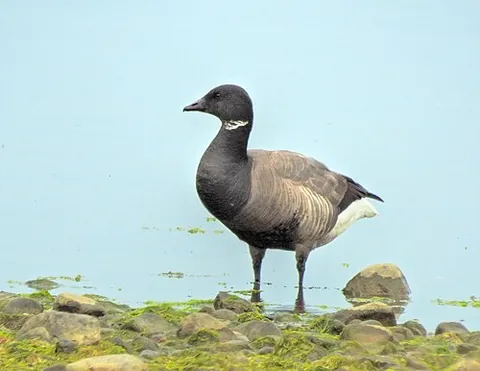
- The brant or brent goose (Branta bernicla).
- Synonyms:
- brant goose, road-goose, rood goose, rot-goose
rout meaning in Tamil, Urdu, Malayalam and Kannada
rout in Tamil
- to rout
- நெரி neri
rout in Urdu
- آشوب, غلہ, ہزیمت, جمگھٹ, شغب, شکست
rout in Malayalam
- പോക്കിരിക്കൂട്ടം, ജനക്കൂട്ടം, ലഹള
rout in Kannada
- ದಿಕ್ಕೆಟ್ಟ ಓಟ, ಕಂಗಾಲಾದ ಪಲಾಯನ, ದೊಂಬಿ, ಗೊಂದಲ, ತುಮುಲ, ಅವಾಂತರ
More languagesFewer languages
- rout in Sanskrit
- भञ्ज् bhañj
Examples of rout in a sentence
- 'Is there anyone in this rout with authority to treat with me?' he asked.1955, J. R. R. Tolkien, The Lord of the Rings: Return of the King, →ISBN, →LCCN, →OCLC, →OL, page 315:
- Researchers in Japan have altered the destiny of a rout of snails by changing the chirality of their shells before birth.26 Nov 2009, James Dacey, “Snail shell spiral switched”, in Physics World:
- When Gospel-Trumpeter surrounded, / With long-ear'd rout to Battel sounded, / And Pulpit, Drum Ecclesiastick, / Was beat with fist, instead of a stick:1662 (indicated as 1663), [Samuel Butler], “[The First Part of Hudibras]. Canto I.”, in Hudibras. The First and Second Parts. […], London...
- Nor do I name of men the common rout, / That wandring looſe about / Grow up and periſh, as the ſummer flie, [...]1671, John Milton, “Samson Agonistes, […].”, in Paradise Regain’d. A Poem. In IV Books. To which is Added, Samson Agonistes, London: […]...
Synonyms of rout
Forms of rout
| Noun | |
|---|---|
| plural | routs |
| Verb | |
| third-person singular present | routs |
| present participle | routing |
| past participle | routed |
| past | routed |
Origin of rout
The noun is derived from Middle English rout, route (“group of people associated with one another, company; entourage, retinue; army; group of soldiers; group of pirates; large number of people, crowd; throng; group of disreputable people, mob; riot; group of animals; group of objects; proper condition or manner”) [and other forms], from Anglo-Norman route, rute, Middle French rote, route, Old French rote, route, rute (“group of people, company; group of armed people; group of criminals; group of cattle”) (modern French route (obsolete)), from Latin rupta (compare Late Latin ruta, rutta (“group of marauders; riot; unlawful assembly”)), the feminine of ruptus (“broken; burst, ruptured”), the perfect passive participle of rumpō (“to break, burst, rupture, tear; to force open; (figurative) to annul; to destroy; to interrupt”), ultimately from Proto-Indo-European *Hrewp- (“to break; to tear (up)”). The English word is a doublet of route. The verb is derived from Middle English routen (“to assemble, congregate; of animals: to herd together; to regroup, make a stand against; to be riotous, to riot”) [and other forms], from rout, route (noun); see above.
The noun is derived from Middle French route (“military defeat; retreat”), from rout, archaic past participle of Middle French, Old French rompre (“to break; to break up, disperse”) (modern French rompre (“to break, snap; to break up (with someone)”)), from Latin rumpere, the present active infinitive of rumpō (“to break, burst, rupture, tear; to force open; (figurative) to annul; to destroy; to interrupt”); see further at etymology 1. The verb is derived from the noun.
The verb is derived from Middle English routen (“to snore; to grunt, snort; to sleep; to dwell; to settle permanently”), [and other forms], from Old English hrūtan (“to snore; to make a noise”), from Proto-West Germanic *hrūtan (“to snore”), from Proto-Germanic *hrūtaną, *hreutaną (“to snore”), from *hruttōną (“to snore; to roar”), from Proto-Indo-European *ker-, *kor-, *kr- (“to croak, crow”), *krut- (“to snore; to roar”), probably ultimately imitative. The English word is cognate with Icelandic rjóta, hrjóta (“to snore; to rattle, roar”), rauta (“to roar”), Middle Dutch ruyten (“to make a noise; to chatter, chirp”), Middle High German rūssen, rūzen (“to make a noise; to buzz; to rattle; to snore”), Norwegian Nynorsk ruta (“to make a loud noise; to roar, rumble”), Swedish ryta (“to bellow, roar; to scream or shout angrily”). Compare Old English rēotan, *hrēotan (“to make a noise; to make a noise in grief, lament, wail; to shed tears, weep”), from Proto-Germanic *reutaną; see further at etymology 4. The noun is derived from the verb. It is cognate with Southern Norwegian rut (“loud noise, din, roar”).
Words formed from rout
Phrases with rout
Words that rhyme with rout
42 more rhymesFewer rhymes
- shout
- sprout
- doubt
- umlaut
- fill out
- grout
- pout
- devout
- drought
- gout
- nowt
- redoubt
- throughout
- without
- ablaut
- dout
- flout
- lout
- mahout
- misdoubt
- mought
- prone out
- strout
- term out
- trout
- zoom out
- 'bout
- anlaut
- aspout
- asprout
- bluff out
- chout
- dought
- knout
- kraut
- layabout
- ne'er cast a clout till May be out
- owt
- peter out
- regrout
- sout
- when in doubt, do nowt
Questions about rout
- What does rout mean?
- Rout means a group of people; a crowd, a throng, a troop; in particular (archaic), a group of people accompanying or travelling with someone.
- What is rout in Tamil?
- Rout in Tamil is நெரி (neri). See Rout meaning in Tamil.
- How do you use rout in a sentence?
- 'Is there anyone in this rout with authority to treat with me?' he asked.
- What part of speech is rout?
- Rout can be a noun or a verb.
- How do you pronounce rout?
- Rout is pronounced /ɹaʊt/ (UK).
- What is the plural of rout?
- The plural of rout is routs.
Words near rout in the dictionary
Source and license
Adapted from Wiktionary: rout (page history and authors); நெரி (Tamil) (page history and authors); rout (Urdu Wiktionary) (page history and authors); rout (Malayalam Wiktionary) (page history and authors); rout (Kannada Wiktionary) (page history and authors); भञ्ज् (Sanskrit) (page history and authors). Text available under the Creative Commons Attribution-ShareAlike 4.0 license. Word.ws reformatted the entry and added links. Wiktionary data of 2026-09-02.
Last updated:
Pronunciation audio from Wikimedia Commons, each file under its own free license: En-uk-rout.ogg, En-us-route.ogg.
Cite this entry: “rout.” Word.ws, https://word.ws/rout. Based on Wiktionary, CC BY-SA 4.0.